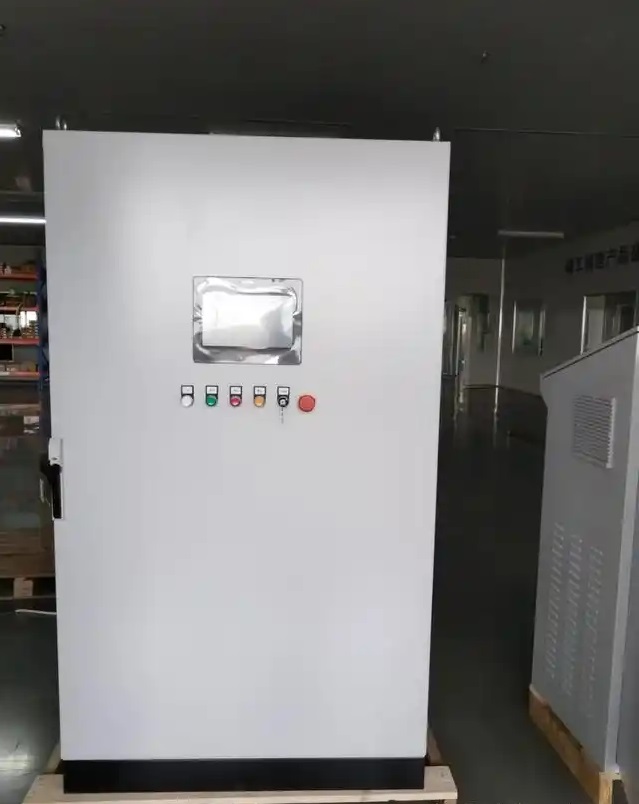
PLC control cabinet, full name is programmable controller control cabinet, is an indispensable and important part of modern industrial automation control system. It takes programmable logic controller (PLC) as the core, integrates multiple functional modules and electrical components, and forms a compact and comprehensive automation control system. PLC control cabinet has a wide range of applications in the field of industrial automation control, which is of great significance for improving production efficiency and ensuring stable operation of equipment.
Basic functions and characteristics of PLC control cabinet
The main function of PLC control cabinet is to realize the automatic control of industrial equipment. It has multiple protection functions such as overload, short circuit, and phase loss protection, which can ensure the stable operation of equipment in complex and changeable industrial environments. PLC control cabinet has compact structure, stable operation, and complete functions. It can be combined according to the actual control scale. It can realize single cabinet automatic control, and can also realize multiple cabinets through industrial Ethernet or industrial field bus network to form a distributed control system (DCS). This flexibility enables PLC control cabinet to adapt to various industrial automation control occasions of various sizes.
One of the characteristics of PLC control cabinet is that its system structure is flexible and easy to expand. It can not only perform switch quantity control, but also perform PID loop control of continuous processes, and can form complex control systems with the host machine, such as DDC and DCS, to achieve comprehensive automation of the production process. In addition, the PLC control cabinet is easy to use and simple to program. It uses concise programming languages such as ladder diagrams, logic diagrams or statement tables, does not require computer knowledge, has a short system development cycle, and is easy to debug on site. More importantly, the PLC control cabinet can adapt to various harsh operating environments, has strong anti-interference ability, and is highly reliable, far higher than other models.
Components and working principles of PLC control cabinet
The components of the PLC control cabinet mainly include PLC body, input and output modules, power modules, communication modules, and other electrical components such as operating tables, alarm lights, buttons and other control components. These control components are customized according to the actual application environment and operating requirements to achieve the control, monitoring and operation of the on-site automation control system.
As the core component of the control cabinet, PLC is responsible for managing the control program and logic functions of the entire system. The input and output module is responsible for inputting the signals of external devices into the PLC and outputting the signals sent by the PLC to external devices. Other electrical components such as power supplies, switches, relays, timers, counters, etc. are all auxiliary equipment of the control cabinet, providing the power supply, protection, control and other functional support required for the normal operation of the control cabinet.
The working principle of the PLC control cabinet is to convert the control instructions of the equipment into electrical signals through the PLC programming language, and then realize the automatic control of the equipment through various logic circuits and electrical components in the control cabinet. Specifically, the working process of the PLC is generally divided into three stages: input sampling, user program execution and output refresh. In the input sampling stage, the PLC reads all input states and data in sequence in a scanning manner, and stores them in the corresponding units in the I/O image area. In the user program execution stage, the PLC executes the user program according to the corresponding state and data in the I/O image area, performs logical operations or arithmetic operations, and sends the results to the I/O image area or data register. In the output refresh stage, the PLC refreshes all output latch circuits according to the corresponding state and data in the I/O image area, and then drives the corresponding peripherals through the output circuit to realize the control of the equipment.
Application fields and typical applications of PLC control cabinets
PLC control cabinets are widely used in the field of industrial automation control and can be used for factory production line control, robot control, workshop automation control, mechanical automation control and other aspects. It can realize functions such as automatic switching, detection, monitoring, and control, and is an advanced automation control system.
In the power industry, PLC control cabinets are widely used in the automation control of power systems, such as automatic monitoring of substations and fault protection of power systems. In the metallurgical industry, PLC control cabinets can be used for the automation control of equipment such as blast furnaces, converters, and continuous casting machines to improve production efficiency and reduce energy consumption. In the chemical industry, PLC control cabinets can be used for the automation control of chemical production lines to achieve automatic proportioning of raw materials and automatic control of reaction processes. In addition, PLC control cabinets are also widely used in industries such as papermaking and environmental sewage treatment, providing strong support for the automation control of these industries.
Typical applications of PLC control cabinets include constant pressure water supply, air compressors, fan pumps, central air conditioners, port machinery, machine tools, boilers, papermaking machinery, food machinery, etc. For example, in a constant pressure water supply system, the PLC control cabinet can automatically adjust the speed of the water pump according to the change of water pressure to maintain the stability of water pressure. In the air compressor control system, the PLC control cabinet can automatically start and stop the air compressor according to the change of air pressure to achieve energy saving and consumption reduction. In the fan pump control system, the PLC control cabinet can automatically adjust the operating status of the fan pump according to the changes in parameters such as flow and pressure to improve the operating efficiency of the system.
Future development trend of PLC control cabinet
With the continuous development of industrial automation, PLC control cabinets are also constantly innovating and improving. In the future, PLC control cabinets will develop in the direction of higher performance, more intelligent and more reliable.
On the one hand, the PLC control cabinet will adopt a higher performance PLC host and input and output modules to improve the processing speed and control ability of the system. At the same time, the PLC control cabinet will integrate more functional modules and sensors to achieve more complex automation control tasks. On the other hand, the PLC control cabinet will develop in the direction of intelligence, and realize the autonomous learning and optimization control of the equipment by integrating artificial intelligence algorithms and machine learning technologies. This will further improve the automation and intelligence level of the system.
In addition, the reliability of PLC control cabinets will be further improved. Manufacturers will adopt more advanced manufacturing processes and materials to improve the anti-interference ability and environmental adaptability of PLC control cabinets. At the same time, PLC control cabinets will adopt redundant systems and fault detection technologies to ensure that the system can quickly switch and resume operation when a fault occurs, ensuring the stable operation of the equipment.
As an important part of modern industrial automation control systems, PLC control cabinets play an important role in the field of industrial automation control with their compact structure, comprehensive functions and high reliability. Through continuous technological innovation and improvement, PLC control cabinets will develop in the direction of higher performance, more intelligence and more reliability, providing more advanced solutions for industrial automation control. In the future, PLC control cabinets will be applied and promoted in more fields, providing strong support for the automation, intelligence and efficiency of industrial production.