In the era of smart manufacturing and industrial automation, production efficiency and precision are no longer optional advantages but core competitive benchmarks for global manufacturers. Behind every high-speed, high-precision automated production line, CNC machine tool, and industrial robot lies a critical yet often underrated component: the servo drive. As the core motion control unit of modern industrial systems, servo drives act as the vital bridge between upper-level control systems and executive motors, translating digital commands into precise mechanical motion. They have become an indispensable cornerstone of high-efficiency, high-quality, and low-consumption modern manufacturing operations.
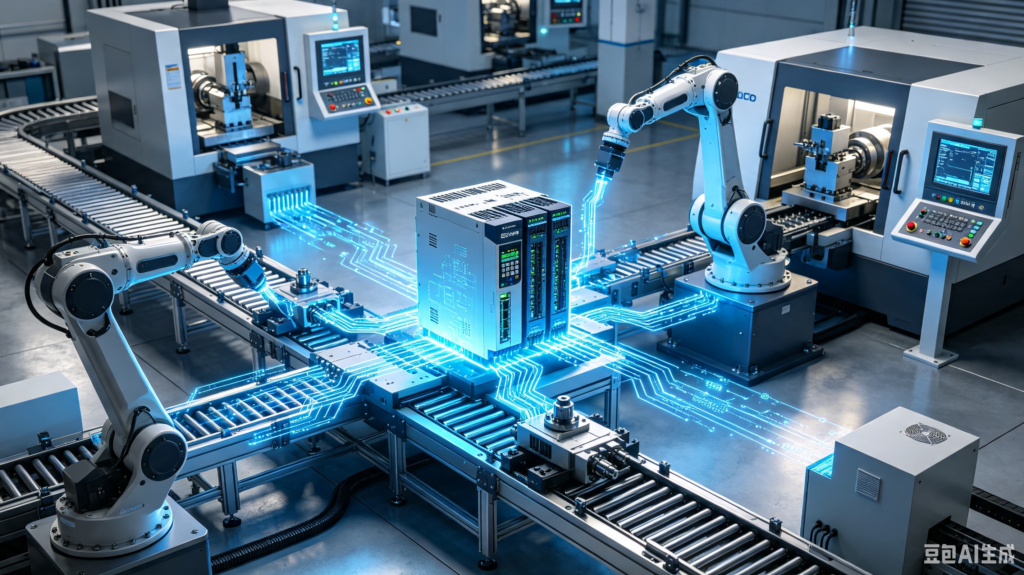
To understand the value of servo drives, it is essential to clarify their core working principle. Unlike traditional variable-frequency drives that only regulate motor speed roughly, servo drives adopt advanced closed-loop control technology. They continuously collect real-time feedback data on motor position, speed, and torque through high-precision encoders, dynamically adjust output signals, and correct motion deviations in milliseconds. This closed-loop mechanism enables precise control of mechanical movement, achieving positioning accuracy up to micrometer levels and stable torque output even at zero speed. This fundamental technical advantage distinguishes servo systems from traditional drive equipment and meets the stringent precision requirements of sophisticated manufacturing scenarios.
The most prominent contribution of servo drives to modern manufacturing isultra-high precision and repeatable motion control. In precision machining, aerospace component processing, semiconductor manufacturing, and pharmaceutical packaging, tiny motion errors will lead to product defects or batch scrapping. For CNC milling machines, laser cutters, and waterjet cutting equipment, servo drives ensure accurate tracking of preset tool paths and stable operation of cutting speed. In servo-electric press brakes and stamping equipment, they deliver controllable bending and pressing sequences to avoid material deformation and dimensional errors. Such precise and repeatable motion control effectively reduces production waste, stabilizes product quality, and greatly improves product qualification rates in mass production.
Beyond precision, servo drives significantly boost manufacturing productivity and operational flexibility. Modern manufacturing features diversified orders and flexible production, requiring production lines to switch quickly between different processes and products. Servo drives support rapid acceleration and deceleration, short cycle times, and flexible parameter tuning, enabling automated lines to adapt to variable production demands. In robotic arms, packaging machines, and textile automation equipment, their millisecond-level response speed optimizes production rhythms, eliminates idle time, and substantially improves line throughput. Meanwhile, intelligent servo drives support multi-axis synchronous control, coordinating the collaborative operation of multiple mechanical units to realize complex automated production processes that are impossible with traditional drive systems.
Energy efficiency and intelligent operation are another key value of servo drives in sustainable manufacturing. Traditional industrial motors often operate with constant power output, resulting in serious energy waste under low-load or intermittent working conditions. In contrast, servo drives output power dynamically according to actual load demand, effectively reducing no-load energy consumption. Data shows that servo drive transformation can help manufacturing enterprises reduce comprehensive energy consumption by 15% to 30%. In addition, with the integration of industrial Internet and AI technology, modern servo drives are evolving toward intelligence. They support real-time data monitoring, automatic parameter optimization, vibration suppression, and predictive maintenance, helping enterprises realize equipment state management, reduce downtime and maintenance costs, and lay a foundation for digital and intelligent factory construction.
Looking ahead, as manufacturing continues to upgrade toward intelligence, flexibility, and greenization, the role of servo drives will become more prominent. The integration of high-precision control, intelligent algorithms, and industrial digital technology will further expand their application boundaries in new energy equipment, intelligent logistics, and precision automation fields. For modern manufacturers seeking to balance precision, efficiency, and cost control, high-performance servo drives are no longer just auxiliary equipment but core power support for industrial upgrading and competitive improvement.