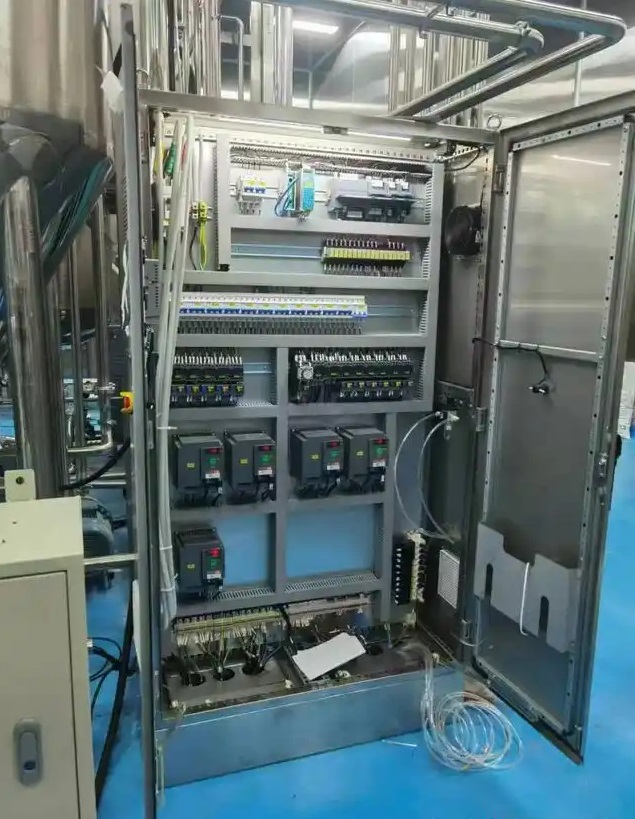
As a leader in the field of industrial automation, Siemens S7-1500 PLC (Programmable Logic Controller) has occupied a place in various industrial control applications with its excellent performance and rich functional features. This article will discuss in detail several core features of Siemens S7-1500 PLC.
Modular design
A highlight of Siemens S7-1500 PLC is its modular design concept. Users can freely select and combine different modules according to actual needs and project scale to meet the requirements of different performance levels. This flexibility not only simplifies system configuration, but also reduces maintenance and upgrade costs. Modular design enables S7-1500 PLC to easily cope with various complex machine designs, from simple automation tasks to complex control systems.
Powerful processing power
The central processing unit (CPU) of S7-1500 PLC uses a high-performance processor to ensure fast and efficient program execution. This powerful processing capability enables the S7-1500 PLC to respond to various industrial control needs in real time, while supporting multi-task parallel processing, thereby performing multiple operations within a work cycle, greatly improving work efficiency. In addition, the S7-1500 PLC also has powerful floating-point computing capabilities, which can handle more complex algorithms and computing tasks to meet the needs of high-end applications.
Multiple input and output modules
In order to meet the needs of different industrial control fields, the S7-1500 PLC provides a variety of input and output modules, including digital input and output, analog input and output, pulse counters, etc. These modules can accurately collect sensor signals, control electrical switches, and process analog signals in various industrial processes. For example, in the manufacturing industry, the S7-1500 PLC can accurately control process parameters such as temperature and pressure through analog input and output modules to ensure the stability of the production process and product quality.
High-speed communication interface
The S7-1500 PLC is equipped with a variety of high-speed communication interfaces, including Ethernet, Profinet, Ethercat, etc., which enables it to easily achieve seamless connection with other devices or systems. These communication interfaces not only improve the speed and reliability of data transmission, but also enhance the flexibility and scalability of the system. Through high-speed communication interfaces, S7-1500 PLC can exchange data in real time, realize remote monitoring and control, and provide strong support for industrial automation.
Rich programming languages
Siemens S7-1500 PLC supports multiple programming languages, including STL (Statement List), LD (Ladder Diagram), IL (Instruction List), FB (Function Block), etc. This multi-language support allows programmers to choose the most suitable programming language for programming according to their own habits and project requirements. At the same time, S7-1500 PLC also supports high-level language programming, such as C/C++, which provides a wider space for customized development.
Reliable security performance
In terms of security, S7-1500 PLC also performs well. It adopts a variety of security measures, including encryption of user data and protection against illegal access, to ensure the security of data transmission and storage. In addition, S7-1500 PLC also supports a variety of security protocols, such as SSL, HTTPS, etc., which further enhances the security of the system. These security features enable S7-1500 PLC to provide more reliable protection in key industrial control applications.
Good scalability
Siemens S7-1500 PLC not only has a high-performance processor and a variety of input and output modules, but also supports a variety of communication interfaces and programming languages. These features make S7-1500 PLC have good scalability and can be flexibly configured and upgraded according to actual needs. Whether it is adding new functional modules or expanding the system scale, S7-1500 PLC can easily cope with it and meet the ever-changing market needs.
Easy to operate and maintain
S7-1500 PLC has a user-friendly operation interface and easy maintenance. Users can easily program, debug and monitor through the operation interface. At the same time, S7-1500 PLC also supports online fault diagnosis and remote maintenance functions, allowing maintenance personnel to quickly locate and solve problems, reducing maintenance costs and time. In addition, S7-1500 PLC also provides rich diagnostic information and alarm functions to help users discover and handle potential faults in time and ensure the stable operation of the system.
Adapt to harsh environments
In the field of industrial control, equipment often needs to operate in harsh environments. Siemens S7-1500 PLC has a sturdy shell and good heat dissipation performance, and can operate stably in harsh environments such as high temperature, humidity, and vibration. At the same time, S7-1500 PLC also supports a variety of anti-interference technologies, such as electromagnetic compatibility design, signal filtering, etc., to ensure the stability and reliability of the equipment. These features enable S7-1500 PLC to perform well in various complex industrial environments.
In summary, Siemens S7-1500 PLC has demonstrated excellent performance and broad application prospects in the field of industrial automation with its modular design, powerful processing power, multiple input and output modules, high-speed communication interface, rich programming language, reliable safety performance, good scalability, easy operation and maintenance, and ability to adapt to harsh environments. Whether in the fields of manufacturing automation, process control, robot control or energy management, S7-1500 PLC can provide strong support and promote the development of industrial automation.