In a programmable logic controller (PLC), there are five common relays that play an important role in the control system.
- Input relay (I)
The input relay is the window for the PLC to receive external input signals. It is connected to the input terminal of the PLC and is used to reflect the status of the external switch signal. When the external input signal is connected, the corresponding input relay coil is energized, its normally open contact is closed, and the normally closed contact is disconnected.
The main function of the input relay is to transmit the status signal of the external device to the PLC so that the PLC can perform logical operations and control according to these signals. For example, when a button is pressed, the corresponding input relay is triggered, and the PLC can execute the corresponding program according to this signal to control the motor to start or stop and other operations.
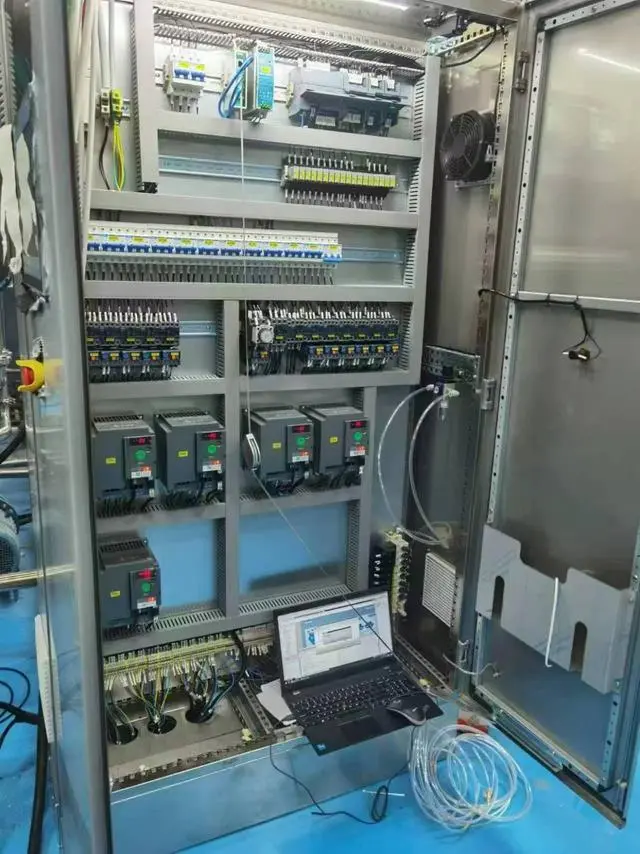
- Output relay (Q)
The output relay is the channel for PLC to output control signals to the outside. It is connected to the output terminal of PLC and is used to control the operating status of external devices. When PLC executes the program, the corresponding output relay coil is energized or de-energized according to the result of the logic operation, thereby controlling the start, stop, forward and reverse rotation of the external device.
The function of the output relay is to transmit the control signal of PLC to the external device to realize the automatic control of the production process. For example, PLC can control the start and stop of the motor, the opening and closing of the valve, the on and off of the light, etc. through the output relay.
- Auxiliary relay (M)
The auxiliary relay plays the role of intermediate transition and auxiliary control in PLC. Unlike input and output relays, it cannot be directly connected to external devices, but is used to store intermediate states, flags, auxiliary contacts of counters and timers, etc.
Auxiliary relays can be divided into general auxiliary relays and special auxiliary relays. General auxiliary relays can be used freely by user programs to store intermediate results and realize logical control. Special auxiliary relays have specific functions, such as clock pulse relays and battery low voltage relays.
Auxiliary relays have a wide range of functions. They can play a role in logic control, state storage, signal transmission, etc. in the program. For example, in a complex control program, auxiliary relays can be used to realize the logical combination of multiple input signals, or store the operating status flag of a certain device.
4. Timer (T)
Timers are used in PLCs to realize timing control functions. It can perform timing operations according to the set time intervals. When the timing time is reached, the contacts of the timer act and trigger the corresponding control program.
Timers can be divided into different types such as power-on delay timers, power-off delay timers, and hold timers. Users can choose the appropriate timer type according to actual control needs and set the timing time.
The main function of the timer is to realize time control in the control system, such as controlling the start time, stop time, and running time of the motor. It can improve the accuracy and reliability of the control system and avoid time inaccuracies caused by human operation errors.
5. Counter (C)
Counters are used in PLCs to realize counting control functions. It can count the number of pulses of the input signal. When the count value reaches the set value, the contacts of the counter act and trigger the corresponding control program.
Counters can be divided into different types such as addition counters, subtraction counters and reversible counters. Users can choose the appropriate counter type according to actual control needs, and set the initial value and set value of the count.
The main function of the counter is to realize counting control in the control system, such as counting the number of products on the production line, recording the number of times the equipment is run, etc. It can improve the automation and production efficiency of the control system and reduce the workload and errors of manual counting.
In summary, the five common relays in PLC – input relays, output relays, auxiliary relays, timers and counters, each play an important role in the control system. They cooperate with each other to realize the automation control of the production process and improve production efficiency and quality.