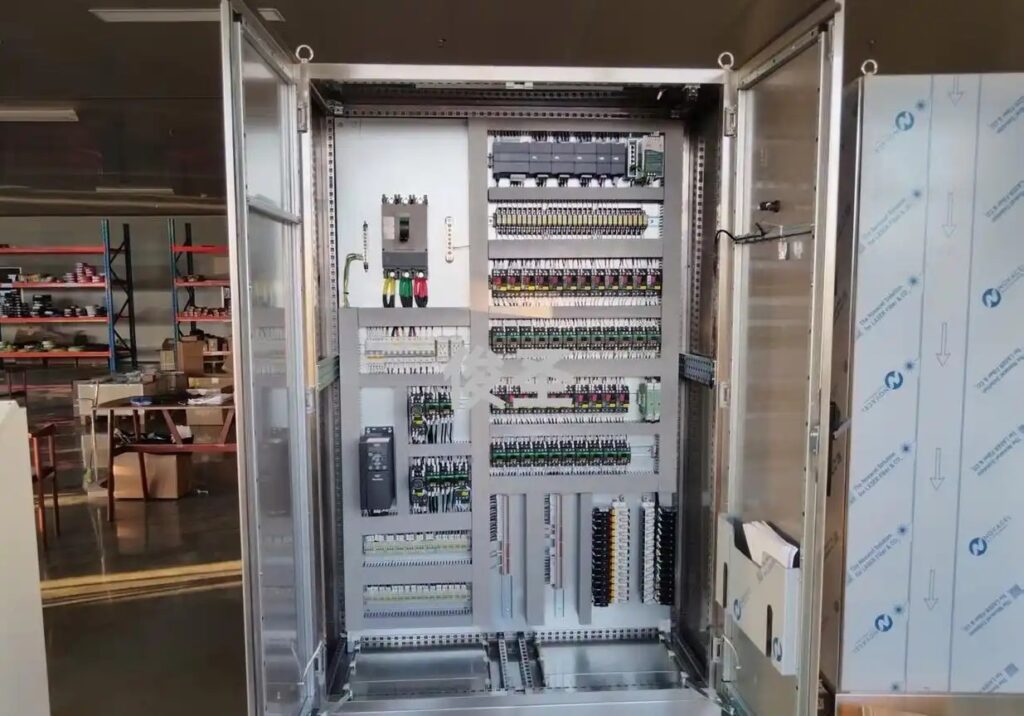
The role of the PLC control cabinet on the milk production line is very critical, mainly reflected in the realization of automated control, ensuring product quality, ensuring equipment safety, and improving management efficiency. The details are as follows:
Automated control of the production process
Precisely coordinate equipment operation: Milk production involves multiple links and many equipment, such as milk from the milk storage tank to the processing equipment, and then to the filling equipment. The PLC control cabinet can accurately control the start, stop, running speed and time of each device through programming, so that they can work together in an orderly manner, realize the automation of the entire production process, improve production efficiency, and reduce manual operation costs.
Realize complex process control: In the standardized process of milk production, the PLC control cabinet can accurately control complex processes such as homogenization, sterilization, and fermentation. Taking the fermentation process as an example, the PLC control cabinet can control the heating and stirring devices of the fermentation tank according to the set time and temperature parameters to ensure that the milk fermentation achieves the best effect.
Quality control and monitoring
Real-time data acquisition: Connected to various detection sensors, real-time collection of key quality data in the milk production process, such as temperature, pressure, flow, pH, component content, etc. For example, during the pasteurization process, the temperature of milk is monitored in real time through a temperature sensor to ensure that the sterilization temperature meets the standard.
Precise quality control: The collected data is analyzed and processed according to the preset quality standards. Once the data exceeds the normal range, an alarm is immediately issued and corresponding measures are taken, such as stopping production or adjusting equipment parameters, to prevent the production of unqualified products. In the filling process, the filling volume can be monitored by a flow sensor, and the situation of exceeding or falling below the standard filling volume can be handled in a timely manner.
Equipment operation and safety assurance
Equipment status monitoring: Real-time monitoring of the operating status of each device on the production line, such as the current, voltage, speed of the motor, vibration, temperature and other parameters of the equipment, timely detection of abnormal conditions of the equipment, early maintenance, reduction of equipment failure downtime, and extension of equipment service life.
Safety protection mechanism: With complete safety protection functions, when overload, short circuit, leakage and other faults are detected, the power supply can be quickly cut off or other protection measures can be taken to prevent equipment damage and accidents, and protect personnel and equipment safety. For example, when the motor is overloaded, the PLC control cabinet will automatically cut off the power supply to the motor to prevent the motor from burning.
Production data management and analysis
Data recording and storage: It can record various data in the production process, including production time, output, equipment operation time, fault records, etc., and store these data in the database to provide detailed data support for production management.
Data analysis and decision support: Analyze the stored data, generate production reports, trend charts, etc., to help managers understand the production status, find problems and potential risks in the production process, and provide decision-making basis for production planning, cost control, quality improvement, etc. For example, by analyzing the output and equipment operation time data, the equipment maintenance plan and production schedule can be reasonably arranged.
Remote monitoring and operation
Remote monitoring function: With the help of communication technology, remote monitoring of the production process can be achieved. Managers can view the equipment operation status, production data and alarm information on the production line in real time through computers or mobile devices in the office or other locations, and keep abreast of the production situation in a timely manner.
Remote operation and adjustment: When necessary, remote operation and parameter adjustment can also be performed to improve the flexibility and convenience of production management. For example, when market demand changes, managers can remotely adjust the filling speed and filling volume of filling equipment to quickly respond to market demand.