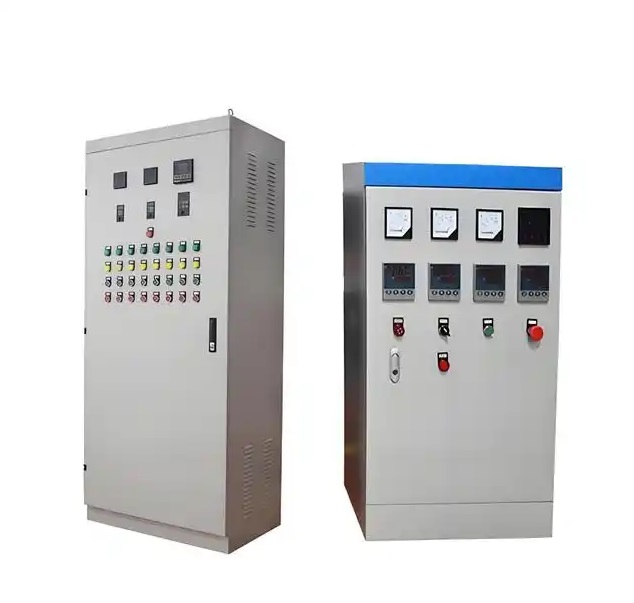
In the field of industrial automation, solenoid valve control cabinets play a vital role. As the core component of the fluid control system, the performance and selection of the solenoid valve control cabinet are directly related to the efficiency, safety and reliability of the production line. Therefore, when choosing a suitable solenoid valve control cabinet, multiple factors must be considered, including usage scenarios, performance requirements, convenience of maintenance and cost-effectiveness.
- Basic composition of solenoid valve control cabinet
Solenoid valve control cabinets are usually composed of solenoid valve groups, other pneumatic components, control circuits and metal outer boxes. Solenoid valves are key components for controlling fluid flow, and their quality and reliability directly affect the performance of the entire system. The control circuit is responsible for receiving and transmitting control signals to achieve remote or local control of the solenoid valve. The metal outer box protects internal components and prevents external interference.
- Selection principles of solenoid valve control cabinets
Clarify usage scenarios and requirements:
Before choosing a solenoid valve control cabinet, you must first clarify its usage scenarios and requirements. For example, is it used for hydraulic systems, pneumatic systems, automated production lines, or water supply systems, air conditioning systems, etc. Different scenarios have different performance requirements for solenoid valve control cabinets, such as pressure, temperature, flow and other parameters.
Consider the degree of automation of the system:
With the development of Industry 4.0 and intelligent manufacturing, the degree of automation is getting higher and higher. Therefore, when selecting a solenoid valve control cabinet, you should consider whether it has remote control, logic control, fieldbus control and other functions. The more intelligent the control cabinet is, the better it can meet the automation needs of the production line and improve production efficiency.
Pay attention to quality and reliability:
As a key equipment, the quality and reliability of the solenoid valve control cabinet are crucial. When selecting, you should choose products with well-known brands and guaranteed quality. At the same time, you should pay attention to indicators such as the service life, performance stability and failure rate of the product.
Consider the convenience of maintenance and maintenance:
The solenoid valve control cabinet needs regular maintenance and maintenance during use. Therefore, when selecting, you should consider whether its structure is reasonable and easy to maintain and maintain. For example, you should choose a solenoid valve that is easy to disassemble and replace, and a control circuit that is easy to inspect and repair.
Pay attention to cost-effectiveness:
When selecting a solenoid valve control cabinet, you should also consider its cost-effectiveness. Although high-quality products may be more expensive, they have a long service life, stable performance, and low failure rate, which makes them more cost-effective in the long run.
3. Functional characteristics of solenoid valve control cabinets
Remote/local switching: Solenoid valve control cabinets usually have two control modes: remote and local. Remote control can be achieved through automation equipment such as PLC and touch screen, which is convenient for operators to monitor and control at a location far away from the site. Local control is achieved through buttons and switches on the control cabinet, which is convenient for manual operation in emergency situations.
Action interlock: To prevent multiple solenoid valves from operating simultaneously due to misoperation or failure, solenoid valve control cabinets usually have an action interlock function. When a solenoid valve is in working state, other related solenoid valves will be locked and unable to operate.
Fieldbus control: With the development of fieldbus technology, solenoid valve control cabinets have gradually acquired fieldbus control functions. Through the fieldbus, communication and data exchange between multiple control cabinets can be achieved, improving the integration and reliability of the system.
Protection and alarm function:
The solenoid valve control cabinet also has protection functions such as overcurrent, overvoltage, and short circuit. When the system is abnormal, it can automatically cut off the power supply to prevent equipment damage. At the same time, the alarm devices such as indicator lights and buzzers can also be used to remind the operator to deal with the fault in time.
4. Industry application of solenoid valve control cabinet
Hydraulic system:
In the hydraulic system, the solenoid valve control cabinet is used to control the flow direction and flow of hydraulic oil to achieve control of actuators such as hydraulic cylinders and hydraulic motors. Through precise control and adjustment, the stability and reliability of the hydraulic system can be improved.
Pneumatic system:
In the pneumatic system, the solenoid valve control cabinet is used to control the flow direction and flow of compressed air to achieve control of actuators such as cylinders and pneumatic motors. The pneumatic system has the advantages of simple structure, light weight, and low cost, and is widely used in the field of industrial automation.
Automated production line:
On the automated production line, the solenoid valve control cabinet is used to control the actions of various pneumatic and hydraulic actuators to achieve automated operation of the production line. Through automation equipment such as PLC and touch screen, remote monitoring and control of the production line can be achieved to improve production efficiency.
Water supply system:
In the water supply system, the solenoid valve control cabinet is used to control the start and stop of the water pump and the opening and closing of the valve to achieve precise control of the water flow. Through the intelligent control algorithm, the water supply system can achieve constant pressure water supply, energy saving and consumption reduction and other functions.
Air conditioning system:
In the air conditioning system, the solenoid valve control cabinet is used to control the flow direction and flow of the refrigerant to achieve precise control of the temperature, humidity and other parameters of the air conditioning system. Through the intelligent control algorithm, the air conditioning system can achieve energy saving and consumption reduction, improve comfort and other functions.
In summary, choosing a suitable solenoid valve control cabinet is of great significance to improving production efficiency, ensuring system safety, reducing energy consumption and failure rate. In the selection process, factors such as usage scenarios, degree of automation, quality and reliability should be comprehensively considered, and products with well-known brands and guaranteed quality should be selected. At the same time, attention should also be paid to the functional characteristics of the product, the convenience of maintenance and cost-effectiveness, etc. Through scientific and reasonable selection and application, significant economic and social benefits can be brought to enterprises.