In a PLC control cabinet, both isolators and circuit breakers play a vital role, but there are clear differences in their functions and applications.
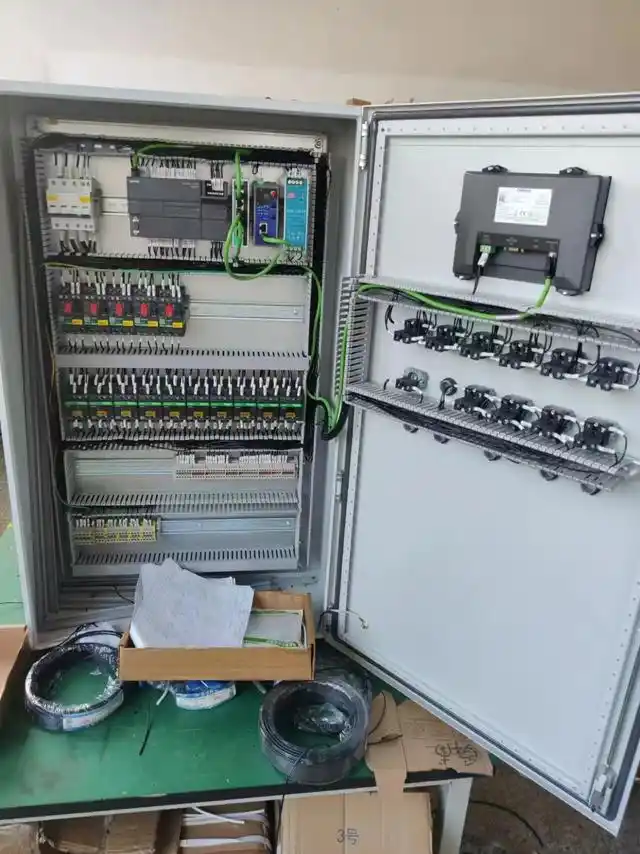
First, from the functional aspect. Isolators are mainly used to isolate electrical equipment from power supplies to ensure the safety of operators when the equipment is maintained, repaired or troubleshooting. It can provide a clear visible disconnection point in the disconnected state, so that people can clearly judge whether the equipment is truly disconnected from the power supply. Isolators usually do not have overload and short-circuit protection functions.
Circuit breakers are electrical equipment with multiple protection functions. It can quickly cut off the power supply when abnormal conditions such as overload and short circuit occur in the circuit to protect electrical equipment and lines from damage. Circuit breakers can be selected and adjusted according to different current levels and protection requirements to meet different application scenarios.
Secondly, there are also differences in structural design. The structure of the isolator is relatively simple, usually consisting of an operating handle, a contact system and a housing. The operating handle is used to manually operate the opening and closing of the isolator, and the contact system is responsible for connecting and disconnecting the circuit. The contacts of the isolator are generally open to provide a clear visible disconnection point in the disconnected state.
The structure of the circuit breaker is more complex, usually consisting of a contact system, an arc extinguishing device, an operating mechanism and a protective device. The contact system is used to connect and disconnect the circuit, the arc extinguishing device is used to extinguish the arc when disconnecting the circuit, the operating mechanism is used to control the opening and closing of the circuit breaker, and the protection device is used to realize overload, short circuit and other protection functions.
In addition, there are differences in application scenarios. Isolators are usually used in occasions where frequent equipment maintenance and overhaul are required, and where the circuit needs to be disconnected under no-load conditions. For example, in a PLC control cabinet, when a certain device needs to be repaired, the device can be isolated from the power supply through an isolator before the maintenance operation is performed.
Circuit breakers are widely used in various electrical systems to protect electrical equipment and lines from overload, short circuit and other faults. In PLC control cabinets, circuit breakers are usually used to protect PLCs, sensors, actuators and other equipment as well as the lines inside the control cabinet.
In summary, there are obvious differences between isolators and circuit breakers in PLC control cabinets in terms of function, structural design and application scenarios. Understanding their differences will help to correctly select and use these two electrical devices and ensure the safe and reliable operation of PLC control cabinets.