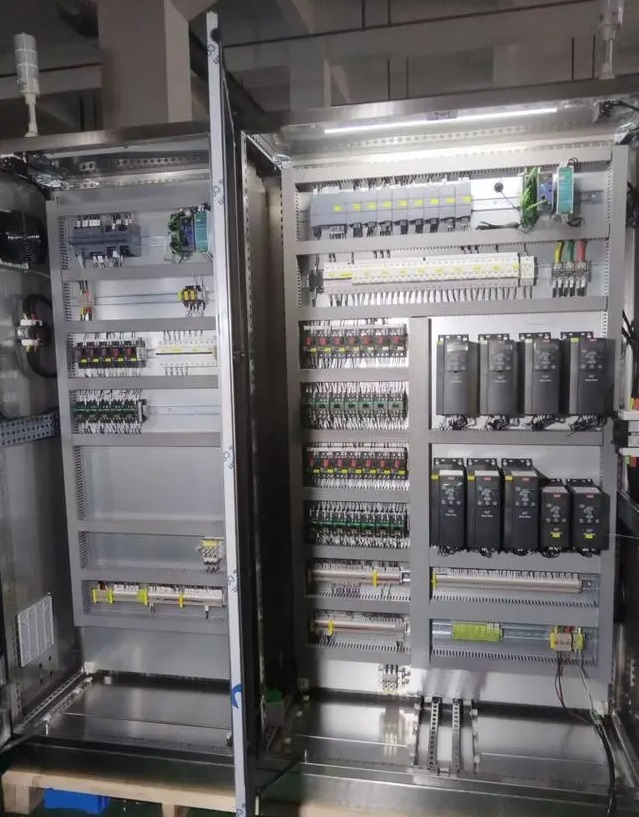
A complete set of electrical control cabinets is a device that integrates a variety of electrical equipment and is used to control, protect, and monitor the operation of electrical systems.
- Basic components
Cabinet
It is the outer shell of the control cabinet, which plays a role in protecting the internal electrical components. The cabinet is generally made of cold-rolled steel plate or stainless steel plate, with a certain strength and sealing, which can prevent external factors such as dust and moisture from invading the internal components. For example, in an industrial environment, the cold-rolled steel plate cabinet can effectively prevent metal dust in the workshop from entering the control cabinet, ensuring the normal operation of electrical components.
The size and structure of the cabinet are diverse, and it can be designed as wall-mounted, floor-standing, etc. according to different application scenarios and installation requirements. Wall-mounted cabinets are suitable for places with limited space, such as control rooms for small equipment; floor-standing cabinets are often used in large electrical systems because they can accommodate more electrical components and are convenient for wiring and maintenance.
Circuit breaker
A circuit breaker is a protective device used to cut off a circuit. When there are faults such as overload (current exceeds the rated value for a certain period of time) and short circuit (current increases sharply in an instant) in the circuit, the circuit breaker can automatically trip and cut off the circuit, thereby protecting electrical equipment and lines from damage caused by overload and short circuit current.
For example, in the power circuit of a factory, if a high-power motor suddenly has a short circuit fault, the circuit breaker connected to the motor circuit will operate in a very short time to prevent the short circuit current from causing serious damage to the motor, cable and other connected equipment.
Contactor
Contactors are mainly used to control the on and off of circuits, especially in equipment that needs to be started and stopped frequently. It closes or opens the contacts through the action of electromagnetic force, thereby achieving control of loads (such as motors).
Take the elevator control system as an example. When the elevator car needs to rise or fall, the contactor in the control system will close the corresponding circuit according to the command, start the elevator motor, and drive the car to run. When the car reaches the specified floor, the contactor will disconnect the circuit again to stop the motor from rotating.
Relay
A relay is an automatic switching device that controls large currents with small currents. It can realize functions such as signal conversion, amplification and logic control. In electrical control cabinets, relays are often used to protect circuits and control circuits for signal transmission.
For example, in a temperature control system, when the temperature sensor detects that the temperature exceeds the set value, a weak signal will be sent. After this signal is amplified by the relay, it can control the start of cooling equipment (such as air conditioning compressor) to adjust the temperature.
Fuse
A fuse is a simple and effective short-circuit protection element. When a short-circuit fault occurs in the circuit, the fuse (usually a metal wire or a metal sheet) in the fuse will melt due to the heat generated by the overload current, thereby cutting off the circuit.
For example, in a household circuit, a fuse can prevent fires caused by electrical short circuits. If an electric kettle short-circuits, the fuse in the circuit will quickly melt to prevent excessive short-circuit current from damaging the household power grid.
Buttons and indicator lights
A button is a control element used to manually operate a circuit. By pressing the button, control instructions such as start, stop, and reset can be sent. The indicator light is used to display the working status of the circuit, such as whether the power is on, whether the equipment is running, etc.
In a simple motor control cabinet, there are “start” and “stop” buttons. The operator can press the “start” button to start the motor, and press the “stop” button to stop the motor. At the same time, there is a “run” indicator light. When the motor is running, the indicator light is on; when the motor stops, the indicator light is off, which is convenient for the operator to intuitively understand the working status of the motor.
- Functional characteristics
Control function
The complete set of electrical control cabinets can accurately control various electrical equipment, including the start, stop, forward and reverse rotation of the motor, and the operation mode switching of other equipment. Through the pre-set control logic, automatic control is achieved to improve production efficiency. For example, in an automated production line, the electrical control cabinet can control the action sequence of motors, cylinders and other equipment at each station according to a predetermined program to ensure the smooth operation of the production line.
Protection function
It can provide a variety of protection measures for the electrical system, such as overload protection, short circuit protection, undervoltage protection and overvoltage protection. These protection functions can effectively prevent electrical equipment from being damaged due to abnormal voltage, current and other conditions, and extend the service life of the equipment. Taking undervoltage protection as an example, if the grid voltage suddenly drops to a certain level, the electrical control cabinet can cut off the power supply of the equipment in time to avoid damage to the motor and other equipment due to long-term operation under low voltage.
Monitoring function
Some advanced electrical control cabinets are equipped with monitoring systems that can monitor electrical parameters such as voltage, current, power, temperature, etc. in real time. By monitoring these parameters, potential failures of the equipment can be discovered in time and maintenance measures can be taken in advance. For example, the temperature in the electrical control cabinet is monitored by a temperature sensor. When the temperature exceeds the set value, an alarm signal can be issued to remind the staff to check whether the cooling system is normal.
- Application field
Industrial field
On the production line of the factory, a complete set of electrical control cabinets is used to control various machine tools, automation equipment, conveyor belts, etc. For example, in an automobile manufacturing factory, the electrical control cabinet controls the operation of welding robots, painting equipment, motors of assembly production lines and other equipment to ensure efficient and accurate automobile production.
Construction field
Control of elevator systems, central air-conditioning systems, fire protection systems, etc. in buildings. In the elevator control cabinet, it controls the elevator’s lifting and lowering, the door’s opening and closing, and other actions; in the central air-conditioning control cabinet, it controls the operation of equipment such as compressors and fans to adjust the indoor temperature.
Power system
In places such as substations and distribution rooms, electrical control cabinets are used to control the operation of equipment such as transformers and switch cabinets to achieve power distribution and conversion. For example, the control cabinet controls the circuit breaker in the substation to achieve power supply and power outage operations on different lines.