Clear control requirements
First, we must clearly understand the specific control tasks in the petrochemical production process, such as the control accuracy and range of parameters such as temperature, pressure, flow, and the logical requirements of equipment start-stop, interlocking control, etc., so that we can choose the right PLC control cabinet to meet the needs of precise control and stable operation.
Performance requirements
Processing capacity: The chemical petroleum production process is complex and the control tasks are numerous. It is necessary to select a suitable CPU according to the complexity of the actual control tasks and the amount of data processing. For example, large chemical plants may need to process a large amount of real-time data and complex control algorithms, and high-performance CPU modules should be selected, such as the CPU 1516 in the Siemens S7-1500 series.
I/O points: Accurately count the required input and output points, including digital input and output points and analog input and output points. Considering the possibility of changes in the production scale and process flow of the chemical and petroleum industry, a 10%-20% margin should generally be reserved.
Communication interface: The chemical and petroleum industry often requires PLC to communicate with a variety of equipment, such as DCS systems, host computers, field instruments, etc. Therefore, it is necessary to select a PLC control cabinet that supports a variety of communication protocols and interfaces, such as PROFINET, Ethernet/IP, Modbus TCP, etc.
Safety and reliability
Protection level: The chemical and petroleum production environment is harsh, with corrosive gases, high temperatures, high humidity, etc. PLC control cabinets should have a higher protection level, generally requiring IP54 or higher, to prevent dust, moisture and corrosive substances from entering the control cabinet and affecting the normal operation of the equipment.
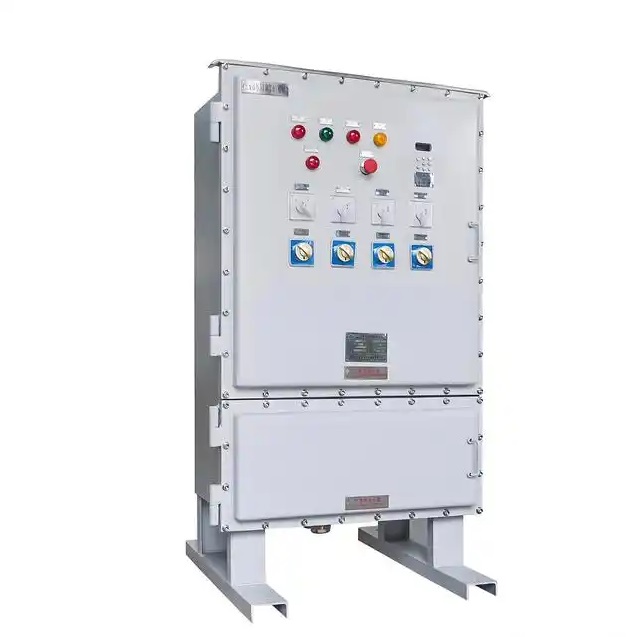
Explosion-proof requirements: There are flammable and explosive hazardous areas in this industry. PLC control cabinets and related equipment used in these areas must have explosion-proof certification, such as flameproof type, increased safety type, etc., to ensure safe operation in hazardous environments. Intrinsically safe PLC modules and explosion-proof control cabinet housings can be selected, or effective explosion-proof isolation measures can be taken.
Reliability: The chemical and petroleum production process is continuous and uninterrupted, requiring the PLC control cabinet to have high reliability and stability. Choose well-known brands and reliable products, and check their application cases and user reviews in the chemical and petroleum industry.
Scalability and compatibility
Scalability: Considering the future development of the enterprise and the improvement of production processes, the PLC control cabinet should have good scalability and be able to easily increase the number of I/O points, communication interfaces, functional modules, etc. Choose a modular PLC and ensure the compatibility and diversity of its expansion modules so that the system functions can be flexibly expanded when needed.
Compatibility: The PLC control cabinet needs to be compatible with various equipment and systems in the chemical and petroleum industry, such as sensors, actuators, DCS systems, SCADA systems, etc. When selecting, it is necessary to fully understand the communication protocol and interface standards of the PLC control cabinet to ensure that it can be seamlessly connected with existing equipment and systems.
Environmental adaptability
Temperature range: The temperature at the chemical and petroleum production site varies greatly, and the PLC control cabinet should be able to work normally in a wide temperature range, generally requiring an operating temperature range between – 20℃ and + 60℃. If the ambient temperature is too high or too low, additional cooling or heating measures may be required.
Humidity requirements: A high humidity environment may cause equipment to become damp, short-circuit, and other problems. The PLC control cabinet should have good moisture resistance. The relative humidity is generally required to be between 5% and 95%, without condensation.
Vibration resistance: Vibration and shock may exist in chemical production. For example, the operation of equipment such as pumps and compressors will generate vibration. The PLC control cabinet should have a certain vibration resistance to ensure that the internal components are firmly connected and the equipment operates normally.
Other factors
Technical support and training: Choose a supplier that can provide timely and professional technical support so that problems can be quickly resolved when they are encountered during equipment installation, commissioning, and operation. At the same time, the supplier should be able to provide relevant training services to help operators and maintenance personnel become familiar with the operation and maintenance of the PLC control cabinet.
Cost and cost-effectiveness: Under the premise of meeting the requirements of performance, safety, reliability, etc., comprehensively consider the purchase cost, operation cost, maintenance cost, etc. of the PLC control cabinet, and choose a product with high cost-effectiveness. Don’t just pursue low prices and ignore the quality and performance of the product, and don’t blindly choose high-priced products and waste resources.
In short, the selection of PLC control cabinets in the petrochemical industry must take into account many factors and be carefully selected to ensure stable and efficient operation of the production system.