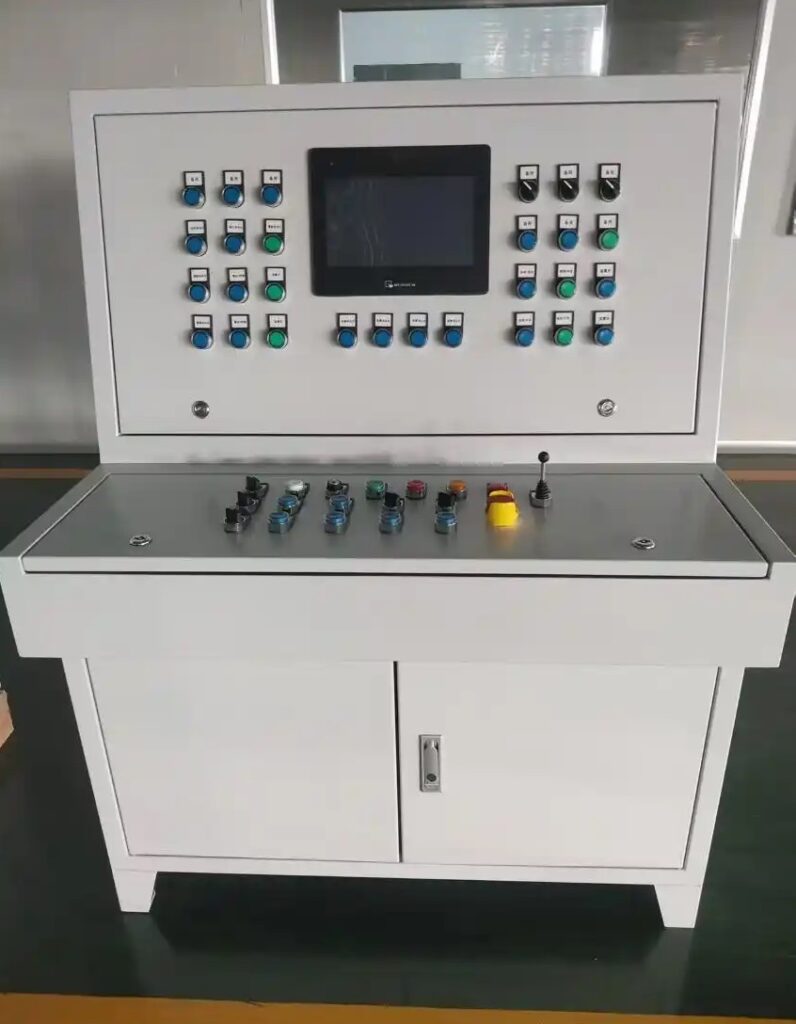
Testing the quality of PLC control cabinets requires the cooperation of multiple tools, and testing from different aspects to ensure the performance and quality of the control cabinet. The following are some commonly used testing tools:
Electrical parameter testing tools
Multimeter: can be used to measure parameters such as AC and DC voltage, current, and resistance. When testing the PLC control cabinet, it can measure whether the power supply voltage is normal, determine whether the line is short-circuited or open-circuited, and detect whether the resistance value meets the standard, so as to determine the basic electrical state of the circuit.
Oscilloscope: mainly used to observe the waveform of electrical signals, and can measure the voltage amplitude, frequency, period, phase and other parameters of the signal. When testing the analog signal, pulse signal, etc. of the PLC control cabinet, it can check whether the signal is stable, whether there is interference, analyze the change law and characteristics of the signal, and help judge the working state of the control system.
Ground resistance tester: specially used to measure ground resistance. For PLC control cabinets, it is very important to ensure that the grounding system is good. Using a ground resistance tester can detect whether the grounding resistance meets the requirements. Generally, the grounding resistance is required to be no more than 4 ohms to ensure the safety of equipment and personnel.
Insulation resistance tester: used to measure the insulation resistance of electrical equipment and lines. It can detect the insulation performance between electrical components in the PLC control cabinet and between the lines and the cabinet to prevent leakage and short circuit faults and ensure the safe operation of the equipment.
Signal detection tool
Signal generator: can generate various standard signals, such as sine wave, square wave, triangle wave, etc., which can be used to simulate the input signal of the PLC control cabinet, test whether the input module of the PLC is working normally, and verify the response of the control system to different signals.
Logic analyzer: mainly used to collect and analyze digital signals, can simultaneously monitor the logic level changes of multiple digital signals, display the timing relationship of the signal, help detect whether the logic function of the digital circuit in the PLC control cabinet is correct, and find logical errors and timing problems.
Mechanical and environmental detection tools
Vernier caliper: used to measure the size of the cabinet, electrical components, etc., to check whether they meet the design requirements, such as the thickness of the cabinet, the spacing of the installation holes of the electrical components, etc., to ensure that the specifications and installation dimensions of each component are accurate.
Thermohygrometer: used to detect the temperature and humidity of the environment where the PLC control cabinet is located to ensure that the environmental conditions meet the equipment requirements. Generally, the suitable working temperature of the PLC control cabinet is 0℃-55℃, and the relative humidity is 5%-95% without condensation to prevent abnormal temperature and humidity from affecting the performance and life of the equipment.
Noise tester: It can measure the noise generated by the operation of the PLC control cabinet. During normal operation, the electrical components in the PLC control cabinet should not generate excessive noise. If the noise is abnormal, it may indicate that the components are faulty or poorly installed.
Software detection tool
Programming software: used to communicate with PLC, upload, download and debug PLC programs. The programming software can monitor the operating status of the PLC, view the status of input and output signals, check the execution of the program, modify and optimize the program, and ensure the correctness and stability of the PLC program.
Fault diagnosis software: Some PLC manufacturers provide special fault diagnosis software that can perform comprehensive fault diagnosis on PLC control cabinets, detect hardware faults, communication faults, program errors, etc., and give corresponding fault prompts and solutions to help quickly locate and eliminate faults.