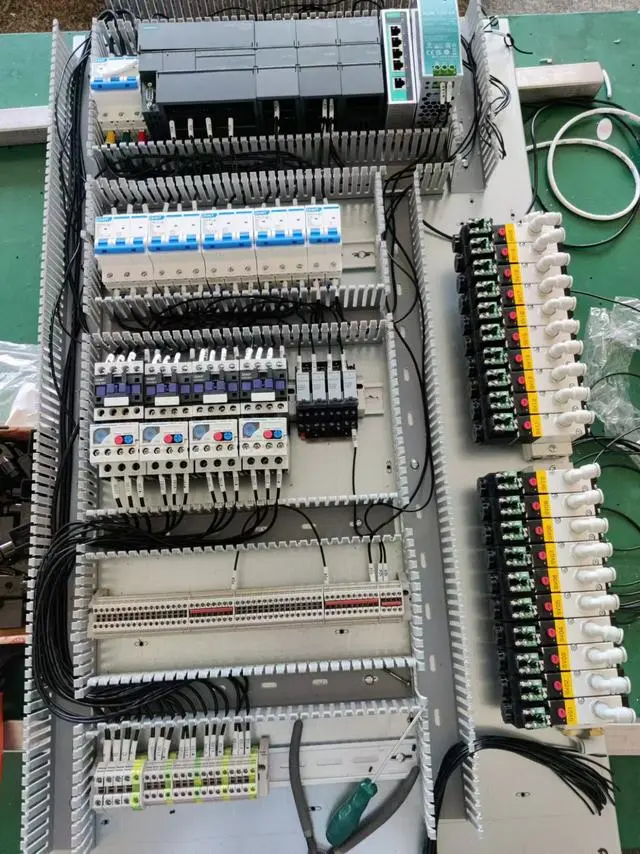
- About the installation of isolators
Correct selection:
Select an isolator of appropriate specifications according to the operating voltage, current and other parameters of the control cabinet to ensure that it can withstand the load requirements of the system.
Consider the protection level of the isolator to adapt to the environmental conditions of the control cabinet, such as dustproof, waterproof, moisture-proof, etc.
Installation location:
The isolator should be installed in a location that is easy to operate and maintain, so that it can be easily isolated when needed.
Avoid installing the isolator in areas with high temperature, high humidity or strong vibration to avoid affecting its performance and life.
Reliable connection:
Ensure that the connection between the isolator and the power supply and load is firm and reliable, and use appropriate wiring terminals and connection methods.
Check whether the cross-sectional area of the connecting wire meets the current requirements to avoid heating or failure due to too thin wires.
Clear marking:
The isolator should be clearly marked with its purpose, control object and other information to facilitate identification and operation by operators.
Clearly mark the operating handle of the isolator to indicate its opening and closing status.
- About circuit breaker installation
Selection and matching:
Select a suitable circuit breaker according to the load type and capacity of the control cabinet, such as a miniature circuit breaker, a molded case circuit breaker, etc.
Consider the short-circuit breaking capacity, overload protection characteristics and other parameters of the circuit breaker to ensure that it can quickly cut off the power supply in the event of a fault.
Firm installation:
The circuit breaker should be installed on a stable mounting plate, using suitable fixings to prevent loosening or displacement during operation.
Avoid installing the circuit breaker in a position that is easily impacted by external forces to avoid affecting its normal operation.
Wiring specifications:
Strictly follow the wiring diagram of the circuit breaker to ensure that the power line and the load line are connected correctly.
Pay attention to the tightening strength of the terminal to avoid poor contact or heating due to looseness.
Protection settings:
Set the overload protection current and short-circuit protection current of the circuit breaker according to actual needs to ensure that the power supply can be cut off in time when a fault occurs.
Regularly check whether the protection settings of the circuit breaker meet the requirements and adjust them if necessary.
Heat dissipation considerations:
For larger capacity circuit breakers, heat dissipation should be considered to ensure that there is enough space around for air circulation.
Avoid installing the circuit breaker in a closed space to prevent poor heat dissipation from affecting its performance and life.
In short, when installing isolators and circuit breakers in the PLC control cabinet, the relevant standards and specifications should be strictly followed to ensure installation quality and reliability, and to provide protection for the safe and stable operation of the PLC control system.