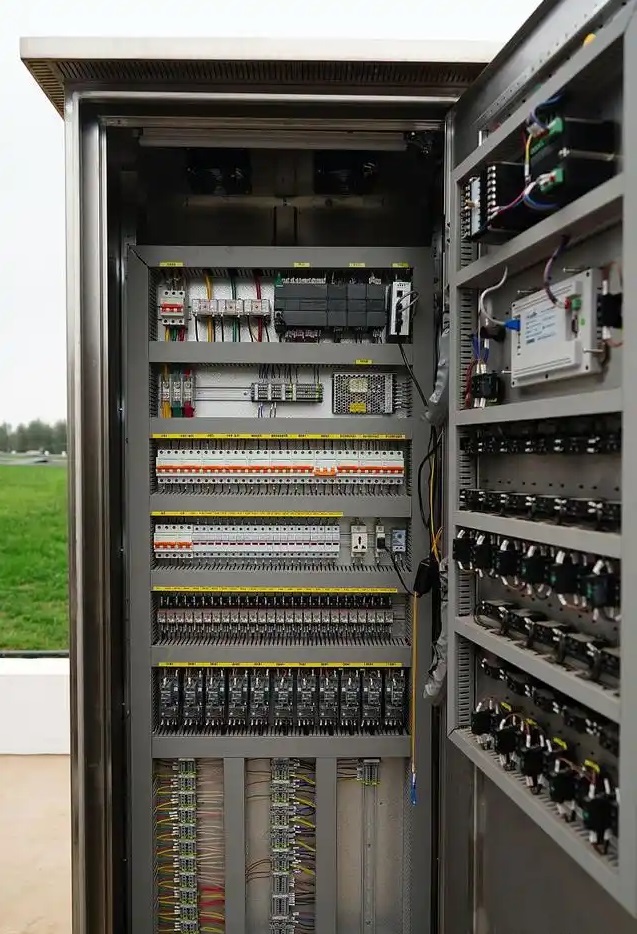
As a vital automation control equipment in water conservancy facilities and water supply systems, the stable operation of the gate pump station PLC control cabinet is directly related to the safety and efficiency of the entire system. Therefore, it is particularly important to carry out scientific and reasonable maintenance. This article will introduce the maintenance methods of the gate pump station PLC control cabinet in detail from multiple aspects such as daily inspection, cleaning and maintenance, troubleshooting, software maintenance and preventive maintenance, aiming to provide a comprehensive and practical operation guide for relevant practitioners.
Daily inspection
Daily inspection is the basis for ensuring the normal operation of the PLC control cabinet, and should be carried out regularly, including but not limited to the following:
- Appearance inspection: Observe whether the control cabinet shell has any signs of deformation, rust or damage, whether the fasteners are loose, and whether the sealing strip is intact to prevent water vapor and dust from intruding.
- Indicator light status: Check whether each indicator light (such as power indicator light, operation indicator light, fault indicator light, etc.) is displayed normally, and preliminarily judge the system operation status according to the indicator light status.
- Ambient temperature and humidity: Use a thermometer and hygrometer to detect the inside and surrounding environment of the control cabinet to ensure that the temperature is between -10℃ and 55℃ and the humidity does not exceed 85% (no condensation) to avoid damage to electronic components caused by high temperature and humidity.
- Cables and wiring: Check whether the cables are damaged or aged, whether the terminals are loose or corroded, ensure reliable connections, and avoid short circuits or open circuits.
- Cooling system: For control cabinets equipped with fans or air conditioning systems, check their operating status to ensure good heat dissipation and prevent overheating.
Cleaning and maintenance
Cleaning and maintenance are key measures to extend the service life of PLC control cabinets. The following steps should be followed:
- Power-off operation: Before any cleaning work, the power supply of the control cabinet must be cut off and a “No Closing” warning sign must be hung to ensure safety.
- External cleaning: Use a soft dry cloth or vacuum cleaner to remove dust and debris from the surface of the control cabinet. Avoid using wet cloth or corrosive cleaners to avoid damaging the outer shell coating.
- Internal cleaning: Under the guidance of professionals, open the control cabinet door and use compressed air or a vacuum cleaner to clean the dust on the circuit board, terminal blocks and other parts. Be careful not to blow directly to the electronic components to prevent static damage.
- Filter replacement: For control cabinets equipped with air filters, regularly check and replace the filters to prevent dust accumulation from affecting the heat dissipation effect.
Troubleshooting
When a PLC control cabinet fails, troubleshooting and repair should be carried out in a timely manner. The steps are as follows:
- Fault record: Record the fault phenomenon, occurrence time and operating environment in detail to provide a basis for fault analysis.
- Preliminary diagnosis: According to the fault indicator, alarm code or error information, combined with the PLC manual, make a preliminary diagnosis to determine the scope of the fault.
- Hardware inspection: Check the hardware modules related to the fault, such as power module, CPU module, input and output module, etc., to confirm whether they are damaged or have poor contact.
- Software diagnosis: Use PLC programming software to download the program and check the program logic to find possible programming errors or improper parameter settings.
- Repair and testing: Replace damaged hardware, correct program errors, re-power on and test to ensure that the fault is completely eliminated.
Software maintenance
Software maintenance is an important part of ensuring the stable operation of the PLC control system, including:
- Program backup: Regularly back up the PLC program to prevent program loss or damage, and facilitate quick recovery.
- Version upgrade: Pay attention to software updates released by PLC manufacturers and upgrade the version in a timely manner to obtain better performance and new functions.
- Virus protection: Although the PLC system is relatively closed, you still need to be vigilant about viruses introduced through external devices such as USB flash drives, and use special software to scan regularly.
Preventive maintenance
Preventive maintenance aims to detect and solve potential problems in advance through regular inspections and preventive replacements, including:
- Capacitor and battery inspection: Regularly check the status of the filter capacitor and backup battery in the power module, and replace aging or failed components in time to prevent data loss due to sudden power outages.
- Terminal tightening: Regularly tighten all terminals to prevent loosening due to vibration or thermal expansion and contraction.
- Professional testing: Invite professional organizations to conduct comprehensive testing of PLC control cabinets at least once a year, including electrical performance testing, insulation resistance measurement, etc., to ensure the safety and reliability of the system.
- Training and education: Strengthen the operator’s understanding of PLC control cabinets and operation skills training, improve fault response capabilities, and reduce human error operations.
Summary
The maintenance of gate pump station PLC control cabinets is a systematic project, which requires comprehensive consideration from daily inspection, cleaning and maintenance, troubleshooting, software maintenance to preventive maintenance. By implementing scientific and reasonable maintenance measures, not only can the service life of the PLC control cabinet be effectively extended, but also the operating efficiency and safety of the entire water conservancy facilities or water supply system can be significantly improved. Therefore, relevant practitioners should attach great importance to it, incorporate maintenance work into the scope of daily management, ensure that the gate pump station PLC control cabinet always maintains a good working condition, and contribute to the development of water conservancy.