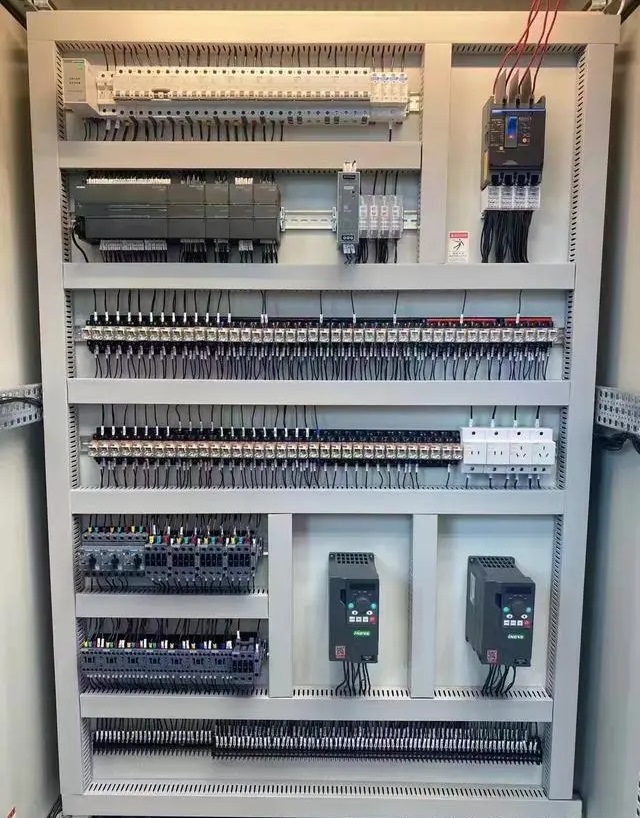
PLC (Programmable Logic Controller) Selection
I/O Point Estimation: First, consider the input and output points of the control object. In food and beverage production, such as a simple beverage filling production line, it may be necessary to control the start and stop of the conveyor belt motor (output point), the bottle detection sensor (input point), the opening and closing of the filling valve (output point), etc. According to the actual number of equipment and control requirements, estimate the required digital input (DI) and digital output (DO) points. If analog control is involved, such as precise adjustment of temperature and pressure, analog input (AI) and analog output (AO) points also need to be considered. Generally, 10% – 20% of the I/O points should be reserved as expansion margin.
Storage capacity considerations: The storage capacity depends on the complexity of the control program. For food and beverage production applications with complex recipe management and multi-step production process control, such as yogurt fermentation production process control, a control program that needs to store multiple recipe parameters and production steps requires a larger storage capacity. The required storage capacity is usually estimated according to the number of steps, data volume and instruction length of the control program.
Processing speed requirements: In high-speed filling, packaging and other production links, the processing speed of PLC is critical. For example, in a high-speed beverage filling production line, it may be necessary to process multiple bottle detection, filling and sealing signals per second, which requires the PLC to have a fast enough scanning cycle. Generally, a PLC with a scanning cycle in milliseconds should be selected to ensure that it can respond and process various control signals in a timely manner.
Brand and compatibility: Choose PLCs from well-known brands on the market, such as Siemens, Mitsubishi, Omron, etc. These brands of PLCs have reliable quality and perfect technical support. At the same time, consider the compatibility of PLC with other components (such as sensors, actuators, HMI, etc.) to ensure that the system can be easily integrated.
Sensor selection
Type selection:
Select the sensor type according to the detection object. In food and beverage production, static pressure liquid level sensors, ultrasonic liquid level sensors, etc. can be selected for liquid level detection. For example, in a beverage mixing tank, a static pressure liquid level sensor can calculate the liquid level height by detecting the liquid pressure to achieve precise liquid level control. For the detection of the presence of materials, such as the position detection of bottles on the conveyor belt, photoelectric sensors can be used. When the bottle blocks the light, the photoelectric sensor will generate a signal.
For temperature detection, thermocouples or thermal resistor sensors can be selected in food baking, sterilization and other links. Thermocouples are suitable for high-temperature environments, such as temperature detection in ovens; thermal resistor sensors are more suitable for occasions with high accuracy requirements and relatively low temperature ranges, such as temperature detection in milk sterilization equipment.
Accuracy requirements: In the food and beverage quality control links, such as raw material ratios, finished product packaging quality inspections, etc., high-precision sensors are required. For example, in a high-precision beverage mixing system, the accuracy of the flow sensor directly affects the accuracy of the beverage formula, and generally a flow sensor with an accuracy of less than ±1% should be selected.
Protection level and material: Since the food and beverage production environment may be relatively humid, corrosive or require frequent cleaning, the sensor should have a suitable protection level. For example, the protection level of sensors used in meat processing workshops must be at least IP67 to prevent the intrusion of water and oil. At the same time, the material of the sensor must meet food hygiene requirements, such as sensors with stainless steel shells to avoid contaminating food.
Actuator selection
Motors and drivers: In food and beverage production equipment, conveyor belt motors, stirring motors, etc. are common actuators. Select the motor according to the power requirements of the production equipment. For example, the stirring motor of a large beverage mixing tank may require several kilowatts of power. At the same time, it is necessary to select a matching motor driver, which should be able to realize the functions of forward and reverse rotation and speed regulation of the motor. In some occasions where precise speed control is required, such as stepless speed regulation of conveyor belts, a variable frequency drive with high-precision speed control capability should be selected.
Valve and actuator: For flow control of liquids and gases, such as beverage filling valves and steam valves, the selection should be based on the pipeline diameter, flow requirements and pressure level. For example, on a large-flow beverage filling line, a large-diameter filling valve should be selected and equipped with a suitable electric or pneumatic actuator. Electric actuators have high control accuracy and pneumatic actuators have fast action speed. They can be selected according to the needs of the actual application scenario.
Contactor and relay selection
Contactor selection: Select the contactor according to the rated current and voltage of the controlled motor or other high-power equipment. In food and beverage production, such as controlling large refrigeration compressor motors, it is necessary to ensure that the rated current of the contactor can withstand the starting current and working current of the motor. At the same time, the service life and operating frequency of the contactor should be considered. For equipment that starts and stops frequently, such as conveyor belt motors, contactors with long service life and high operating frequency should be selected.
Relay selection: Relays are mainly used for signal conversion and isolation. In PLC control cabinets, small relays can be selected for the control of some small signals, such as control indicators, alarms, etc. Consider factors such as the coil voltage of the relay (matching the PLC output voltage) and the contact capacity (capable of withstanding the current and voltage of the load).