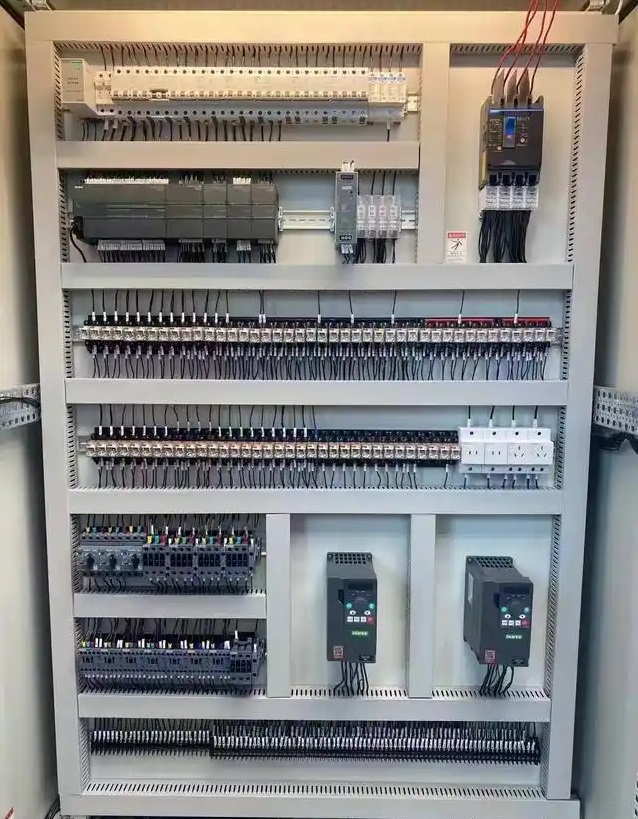
In pharmaceutical production, PLC control cabinets play a vital role. PLC, or programmable logic controller, is a digital computing and operating electronic system designed for industrial environments. It has the advantages of high reliability, strong anti-interference ability, complete functions, wide applicability, easy to learn and use, and less system design, installation, and debugging work, so it has been widely used in pharmaceutical automation. This article will explore in depth why PLC control cabinets are used in pharmaceutical production, and analyze its specific applications and advantages in pharmaceutical production.
First of all, the application of PLC control cabinets in pharmaceutical production is based on the high demand for automated control in the pharmaceutical industry. Pharmaceutical production is a complex and delicate process that requires strict control of each link to ensure product quality and production efficiency. PLC control cabinets can achieve precise control of pharmaceutical production equipment through their powerful control functions and flexibility, thereby meeting the high standards and high requirements of the pharmaceutical industry.
In pharmaceutical production, PLC control cabinets are mainly used to control various equipment and process flows, such as conveying equipment, mixing equipment, packaging equipment, etc. For conveying equipment, PLC control cabinets can accurately control its start, stop, speed, direction and other parameters to achieve automated control, thereby improving production efficiency. For mixing equipment, the PLC control cabinet can accurately control parameters such as mixing time and mixing ratio to ensure the accuracy and consistency of the mixing process. For packaging equipment, the PLC control cabinet can accurately control parameters such as packaging speed and number of packaging bags to achieve automated packaging and improve packaging efficiency and consistency.
In addition to the control of equipment and process flow, the PLC control cabinet can also realize process control in pharmaceutical production. Pharmaceutical production usually involves multiple process steps, such as mixing, stirring, reaction, drying, etc. The PLC control system can automatically control the operation of the equipment according to preset parameters and logical conditions to ensure the accuracy and consistency of the process. This precise control helps to reduce errors and waste in the production process and improve product quality and production efficiency.
In pharmaceutical production, the control of temperature and humidity is also crucial. The PLC control system can cooperate with temperature and humidity sensors to achieve precise control of temperature and humidity in the pharmaceutical production process. This is especially important for some sensitive pharmaceutical processes, because changes in temperature and humidity may affect the quality and stability of the product. Through the precise control of the PLC control system, it can be ensured that the temperature and humidity in the pharmaceutical production process remain within a suitable range, thereby improving product quality and production efficiency.
In addition, PLC control cabinets can also be used for pressure and flow control in pharmaceutical production. Pharmaceutical production lines often involve various equipment such as pumps, valves and regulators. PLC control systems can monitor and control the pressure and flow of these equipment to ensure the normal progress of the pharmaceutical process. Through precise pressure and flow control, the material flow in the pharmaceutical production process can be ensured to be stable and meet the process requirements, thereby improving product quality and production efficiency.
In pharmaceutical production, batch control and traceability are also very important. PLC control systems can track and manage batch production in pharmaceutical production lines, and record and store relevant data and parameters for each batch. This batch control and traceability function helps to ensure compliance and consistency in the pharmaceutical production process, and also provides strong support for quality management and product recall.
The application of PLC control cabinets in pharmaceutical production is also reflected in packaging and labeling control. PLC control systems can control packaging machinery and labeling machines on pharmaceutical production lines to ensure correct packaging and labeling. This can not only improve packaging efficiency and consistency, but also ensure the accuracy and traceability of product information.
In addition to the above functions, PLC control cabinets also have alarm and fault monitoring functions. In pharmaceutical production, equipment failure and downtime may cause production interruptions and product quality problems. PLC control systems can monitor the status of equipment in pharmaceutical production lines and trigger alarms or perform fault diagnosis when abnormal conditions occur. This real-time monitoring and fault diagnosis function helps to detect and handle equipment failures in a timely manner, reducing production interruptions and product quality problems.
In addition, the introduction of PLC control cabinets also helps to improve the intelligence of pharmaceutical equipment. In traditional pharmaceutical processes, almost all pharmaceutical steps require laboratory technicians to operate, which not only leads to low production efficiency, but also easily causes errors and instability due to manual operation. After the introduction of PLC technology, intelligent control of pharmaceutical equipment can be achieved through automated control systems to improve production efficiency, product quality and stability.
The application of PLC control cabinets in pharmaceutical production also brings the benefits of energy conservation and emission reduction. By precisely controlling each link in the pharmaceutical production process, the PLC control system can optimize energy use and reduce energy waste and emissions. This not only helps to reduce production costs, but also meets the current requirements of environmental protection and sustainable development.
In summary, PLC control cabinets play a vital role in pharmaceutical production. It can not only realize the precise control of pharmaceutical equipment and process flow, but also realize the functions of process control, temperature and humidity control, pressure and flow control, batch control and traceability, packaging and labeling control, alarm and fault monitoring, etc. By introducing PLC technology, pharmaceutical companies can improve production efficiency, product quality and stability, reduce production costs and energy waste, and achieve sustainable development. Therefore, PLC control cabinets have been widely used in pharmaceutical production and have become an indispensable part of pharmaceutical automation.