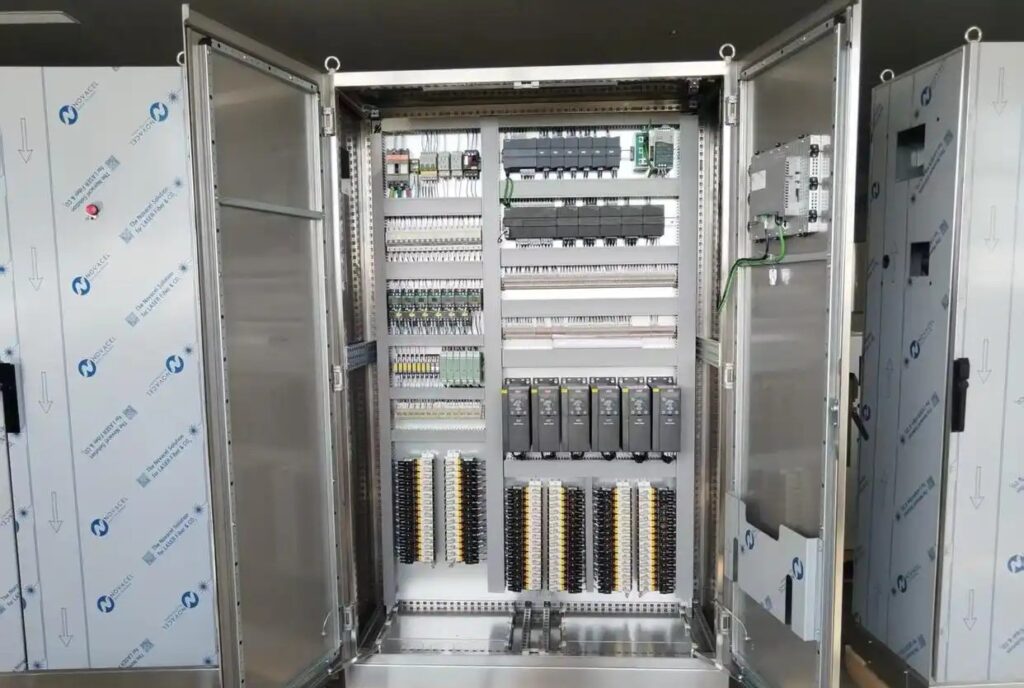
The applicable scenarios of PLC control cabinets with different heat dissipation methods are as follows:
Air cooling
Natural air cooling: Applicable to small PLC control cabinets in scenarios such as small warehouses, small offices, and home automation. The control cabinets in these places have low heat generation, and the ambient temperature is relatively stable and cool, and generally high temperatures do not occur. In addition, some places with extremely high noise requirements, such as precision instrument laboratories and silent studios, natural air cooling does not require fans and other equipment to generate noise, and is also more suitable.
Forced air cooling: It can be used in electronic equipment production workshops, general industrial automation production lines, etc. There are fewer pollutants such as dust in these scenarios, and the environment is relatively clean. The control cabinet needs a certain heat dissipation capacity to cope with the heat generated during normal production. Forced air cooling is also more applicable in scenarios such as auxiliary equipment control in some large data centers and central air conditioning system control in commercial buildings. These places have high requirements for heat dissipation of control cabinets, and the environmental conditions are relatively good, which is suitable for forced air cooling.
Liquid cooling
Direct liquid cooling: commonly used in scenarios such as control of large power substations and core control of large chemical production equipment. The PLC control cabinets in these scenarios need to run at high load for a long time, generate a lot of heat, and have extremely high requirements for the stability and efficiency of heat dissipation. In some places where the temperature control accuracy is extremely high, such as the control of high-performance computing centers and large control centers of high-end medical equipment, direct liquid cooling can accurately control the temperature and ensure the stable operation of the equipment.
Indirect liquid cooling: suitable for electroplating plants and sewage treatment plants with corrosive gases or high humidity environments. The closed circulation system of indirect liquid cooling can avoid contact between the coolant and the external environment to prevent corrosion and condensation problems. In some scenarios such as aerospace ground control stations and military communication control centers with high requirements for electromagnetic compatibility, the indirect liquid cooling system will not produce airflow interference like air cooling, which is conducive to maintaining a good electromagnetic environment.
Heat pipe cooling
It can be used for control of communication base stations and distributed control of outdoor smart grids. The control cabinets in these places are usually installed in cabinets or boxes with limited space. Heat pipe cooling can efficiently dissipate heat in a limited space, with high reliability and reduced maintenance costs. In some green factories and new energy power station control scenarios with high energy-saving requirements, heat pipe heat dissipation does not require additional power equipment, and only relies on its own heat conduction characteristics to dissipate heat, which can effectively reduce energy consumption.
Heat sink heat dissipation
It is suitable for scenarios such as small automation equipment control and simple lighting control systems where there are a small number of heating components in the control cabinet and the overall heat generation is not large. The heat sink can dissipate a small amount of heat in time by increasing the heat dissipation area. In some small processing plants with strict cost control requirements and environmental control of small farms that do not require complex heat dissipation systems, heat sink heat dissipation costs are low and installation is simple, which can meet basic heat dissipation needs.
Air conditioning heat dissipation
It is suitable for occasions such as mechanical processing workshops for automotive parts and tobacco re-drying workshops where the ambient air is particularly dirty. For PLC control cabinets in high-temperature workshops in industries such as metallurgy and steel, the temperature in these places is very high in summer, and ordinary heat dissipation methods are difficult to meet the needs. Air conditioning heat dissipation can ensure stable temperature in the cabinet. In some scenarios such as clean workshop control in pharmaceutical factories with extremely high environmental requirements and control of high-end electronic chip manufacturing workshops, air conditioning heat dissipation can provide a stable temperature and humidity environment to meet production process requirements.