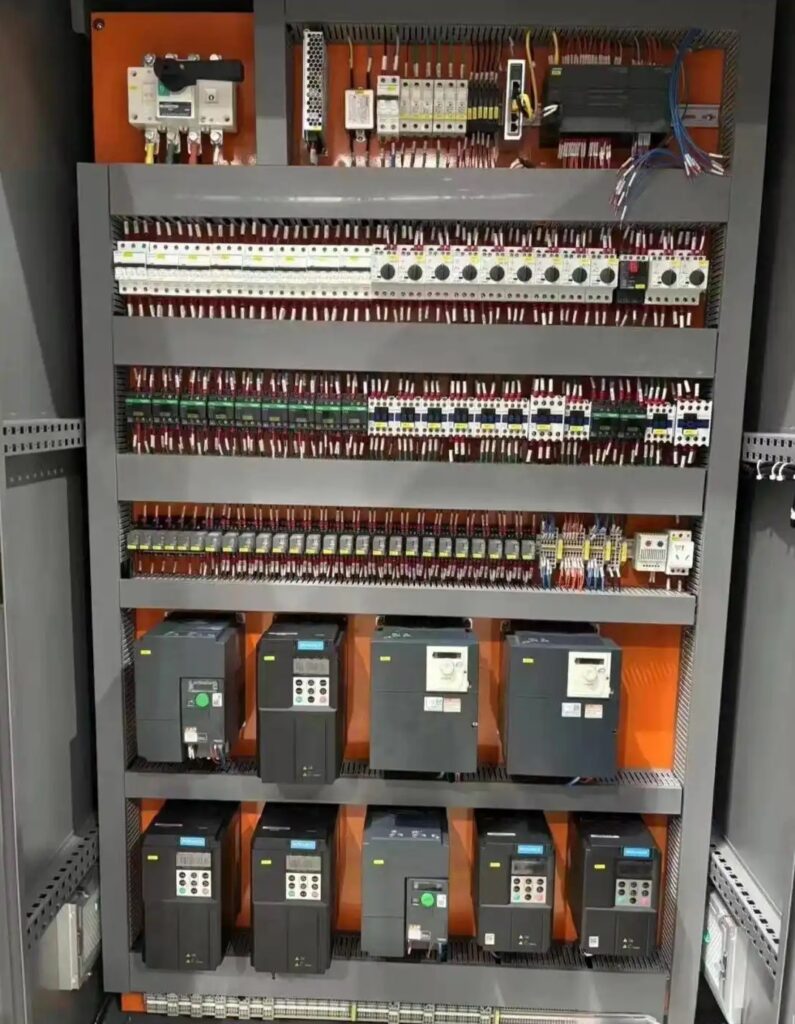
The frequency conversion control cabinet plays an important role in the automation system in many aspects, which is mainly reflected in the following aspects:
Motor control and protection
Speed control: By changing the power supply frequency to adjust the speed of the motor, the motor can run at a suitable speed under different working conditions according to the needs of the automation system, meeting the precise requirements for speed regulation in the production process. For example, in an industrial production line, the speed of the conveyor belt motor can be adjusted according to the production rhythm of the product.
Soft start and soft stop: When starting and stopping the motor, the frequency conversion control cabinet can realize soft start and soft stop functions. It avoids the high current shock and mechanical shock generated in the traditional starting method, prolongs the service life of the motor and related equipment, and also reduces the impact on the power grid.
Motor protection: It has a variety of protection functions, such as overcurrent protection, overvoltage protection, undervoltage protection, overheating protection, etc. When the motor is abnormal, it can detect and cut off the power supply in time to prevent the motor and other equipment from being damaged due to faults, and improve the reliability and stability of the automation system.
Energy saving and consumption reduction
Adjust power on demand: Automatically adjust the output power of the motor according to the change of load. When the load is light, reduce the speed and power of the motor to make the motor run in an efficient and energy-saving state. According to statistics, in some application scenarios such as fans and water pumps, the use of frequency conversion control cabinets for speed control can achieve 30% – 60% energy saving effects.
Optimize operating efficiency: The motor can maintain high efficiency operation under different working conditions, avoiding energy waste caused by the motor running at a non-optimal efficiency point under the traditional constant speed operation mode.
Process control and optimization
Precise control: In the automated production process, the frequency conversion control cabinet can be seamlessly connected and coordinated with other automation equipment and control systems (such as PLC, DCS, etc.). According to the system’s set value and feedback signal, the speed and operating state of the motor are accurately adjusted to achieve precise control of the production process. For example, in chemical production, the speed of the stirring motor can be accurately adjusted according to parameters such as temperature and pressure in the reactor.
Multi-motor collaborative control: Synchronous control or proportional control of multiple motors can be achieved. In some occasions where multiple motors need to work together, such as the multi-roller drive system in the paper production line, the frequency conversion control cabinet can ensure the speed matching between the motors, and ensure the stability of the production process and product quality.
Fault diagnosis and alarm: The built-in intelligent control system can monitor the motor and its own operating status in real time, diagnose and locate the fault, and issue an alarm signal in time. Maintenance personnel can quickly troubleshoot and solve the fault according to the alarm information, reduce equipment downtime, and improve production efficiency.
Improve the production environment and improve product quality
Reduce noise and vibration: Since the frequency conversion control cabinet can achieve smooth speed regulation and soft start and soft stop of the motor, it reduces the impact and vibration during the operation of the motor, thereby reducing the noise generated by the operation of the equipment. This not only improves the working environment, but also reduces the damage to the equipment and plant structure caused by vibration.
Improve product quality stability: In some industries with high requirements for production process precision, such as textiles and printing, the frequency conversion control cabinet can accurately control the speed and operating status of the motor to ensure the stability and consistency of the production process, thereby improving the quality and qualified rate of the product.