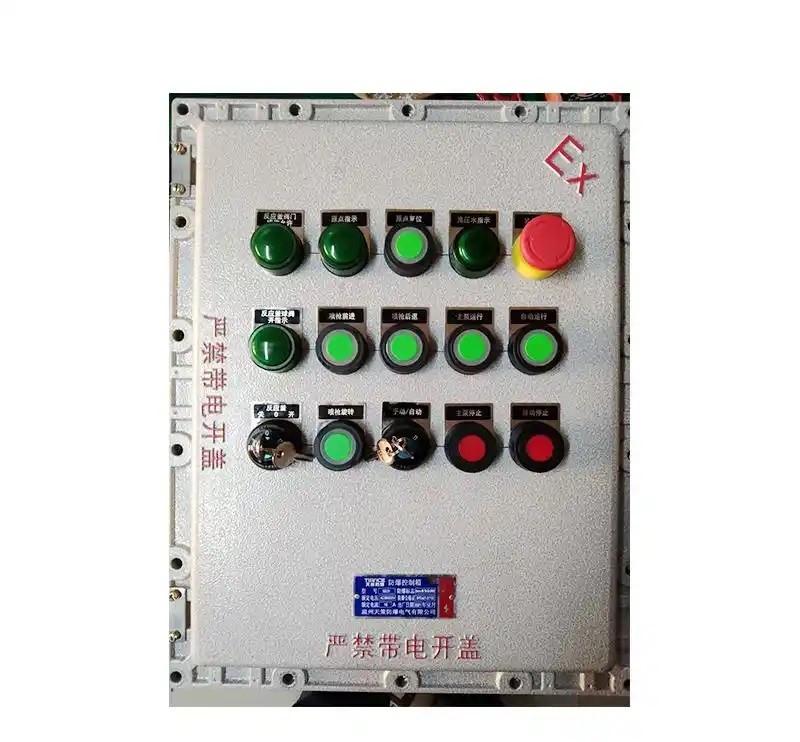
To choose a suitable explosion-proof control cabinet, we need to consider various factors on the basis of clarifying the use environment and work requirements. The following are specific methods:
Clear use environment
Hazardous area level: Determine the hazardous area level, such as Zone 0, Zone 1, and Zone 2, based on the frequency, duration, and degree of danger of flammable and explosive substances in the venue. Zone 0 is the most dangerous area and requires the highest level of explosion-proof equipment.
Gas or dust types: Different flammable and explosive gases or dusts have different explosion characteristics. For example, hydrogen and acetylene are gases with high danger levels, while flour, coal powder and other dusts also have explosion hazards. It is necessary to select a control cabinet with the corresponding explosion-proof level and type according to the specific type of substance.
Ambient temperature and humidity: Ambient temperature and humidity will affect the performance and service life of the explosion-proof control cabinet. In a high temperature environment, it is necessary to select a control cabinet with good heat dissipation performance; in a humid environment, the moisture-proof and rust-proof performance of the control cabinet should be considered.
Corrosion degree: If there are corrosive gases or liquids in the use environment, such as chemical workshops, coastal areas, etc., a cabinet material with corrosion resistance should be selected, such as stainless steel explosion-proof control cabinet.
Determine the work requirements
Control function: Determine the control function that the explosion-proof control cabinet needs to have according to the control requirements of the actual production process. Such as simple start-stop control, temperature control, pressure control, or complex automatic control systems, such as PLC control, DCS control, etc.
Load type and power: Clarify the load type of the equipment to be controlled, such as motors, heaters, solenoid valves, etc., as well as the power of the load. Different load types have different requirements for the electrical performance of the control cabinet. For example, when the motor starts, a large impact current will be generated, and the control cabinet needs to have corresponding overload protection and starting capabilities.
Operation mode: Consider the way to operate the explosion-proof control cabinet, whether it is local manual operation, remote operation, or both. If remote operation is required, the communication method and protocol must also be determined, such as RS485, Profibus, Modbus, etc.
Consider other factors
Reliability and stability: Choose explosion-proof control cabinets with good reputation and brand credibility. Their products are usually more secure in design, manufacturing process and quality control, and can ensure stable and reliable operation during long-term operation.
Maintenance convenience: In order to reduce equipment downtime and maintenance costs, you should choose explosion-proof control cabinets that are easy to maintain. For example, the internal layout of the cabinet is reasonable, the electrical components are easy to replace, and it has a good heat dissipation and ventilation design, which is convenient for maintenance and maintenance personnel to operate.
Cost factors: On the premise of meeting the use requirements, the purchase cost, installation cost, operation cost and maintenance cost of the explosion-proof control cabinet are comprehensively considered. The prices of control cabinets of different brands, specifications and functions vary greatly, and it is necessary to make a reasonable choice based on the budget.
Expandability: Considering the expansion of production scale or process improvement in the future, the explosion-proof control cabinet should have a certain degree of expandability, so that it is convenient to add control loops and expand functional modules when necessary.