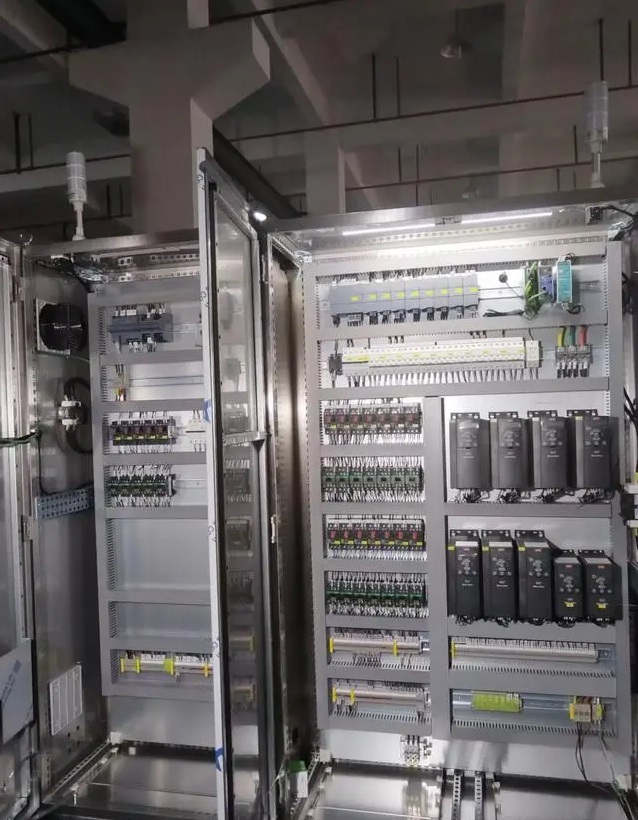
Choosing a PLC control cabinet suitable for the CIB cleaning system requires comprehensive consideration of many factors. Here are some suggestions:
Clear system requirements
Control function requirements: Analyze the specific control requirements of the CIB cleaning system in detail, such as the flow, pressure, and temperature control of the cleaning liquid, the cleaning time, the sequential control of the cleaning process, and the interlocking control with other related equipment. According to these requirements, determine the basic control functions that the PLC control cabinet should have, such as analog input and output control, logic control, and timing control.
I/O point requirements: Count the number of various input and output devices in the CIB cleaning system, including sensors, valves, pumps, motors, etc., to determine the number of input and output points required for the PLC control cabinet. In order to ensure the scalability of the system, it is recommended to reserve 10%-20% of the margin based on the actual number of points required.
Consider performance indicators
Processing speed: According to the control accuracy and real-time requirements of the CIB cleaning system, select a PLC control cabinet with a suitable processing speed. For some links that require high control response speed, such as fast opening and closing valve control, shutdown control in emergency situations, etc., it is necessary to select a PLC with fast scanning speed and short instruction execution time to ensure that the system can respond promptly and accurately.
Storage capacity: Evaluate the control program scale and data storage requirements of the CIB cleaning system, and select a PLC control cabinet with sufficient program storage capacity and data register capacity. If the system’s control logic is complex, the control program is long, or a large amount of operating data, historical data, etc. need to be stored, a larger storage capacity is required to ensure the normal operation of the system.
Focus on reliability and stability
Hardware quality: Select a PLC control cabinet with high-quality electronic components and reliable electrical connections to ensure that there will be no system failures caused by component failures or poor contact during long-term operation. For example, select power modules and I/O modules with good anti-interference capabilities, as well as PLC hosts that have undergone strict quality inspections and certifications.
Environmental adaptability: Consider the working environment of the CIB cleaning system, such as temperature, humidity, dust, corrosive gases, etc., and select a PLC control cabinet with corresponding protection levels and environmental adaptability. For example, in a humid and dusty environment, a control cabinet with a high protection level and good sealing should be selected to prevent moisture and dust from entering the interior and affecting the normal operation of electrical components.
Redundant design: For some CIB cleaning systems with extremely high reliability requirements, you can consider choosing a PLC control cabinet with redundant functions, such as redundant CPU modules, power modules, communication modules, etc. In this way, when the main module fails, the backup module can automatically switch to operation to ensure uninterrupted operation of the system.
Evaluate communication capabilities
Communicate with the host computer: If the CIB cleaning system needs to interact with the host computer for data, remote monitoring and operation, then the PLC control cabinet should have corresponding communication interfaces and communication protocols, such as Ethernet interface, Profibus interface, Modbus TCP/IP protocol, etc., to achieve seamless connection and stable communication with the host computer.
Communicate with other devices: Consider whether there are other intelligent devices or subsystems in the CIB cleaning system that need to communicate and work together with the PLC control cabinet, such as fieldbus devices, intelligent instruments, etc. Ensure that the PLC control cabinet supports the communication protocols and interface types with these devices to achieve overall integration and automated control of the system.
Consider scalability and compatibility
Scalability: Choose a PLC control cabinet with good scalability so that new I/O modules, communication modules, special function modules, etc. can be easily added when the system is upgraded or expanded in the future. For example, a PLC control cabinet with a modular structure can flexibly configure and expand the hardware resources of the system according to actual needs.
Compatibility: Ensure that the PLC control cabinet has good compatibility with the existing equipment and systems in the CIB cleaning system, including electrical compatibility, communication compatibility, software compatibility, etc. Avoid system failure or failure to operate normally due to compatibility issues.
Pay attention to manufacturers and after-sales service
Manufacturer reputation and reputation: Choose a PLC control cabinet manufacturer with good reputation and reputation, and its product quality and after-sales service are more guaranteed. You can understand the reputation of the manufacturer by checking the manufacturer’s historical performance, user evaluation, industry certification, etc.
Technical support and after-sales service: PLC control cabinets may encounter various technical problems during use, and manufacturers are required to provide timely and effective technical support and after-sales service. Therefore, when choosing, you should understand the manufacturer’s technical support team, after-sales service network, response time, etc. to ensure that problems can be resolved quickly when they arise.