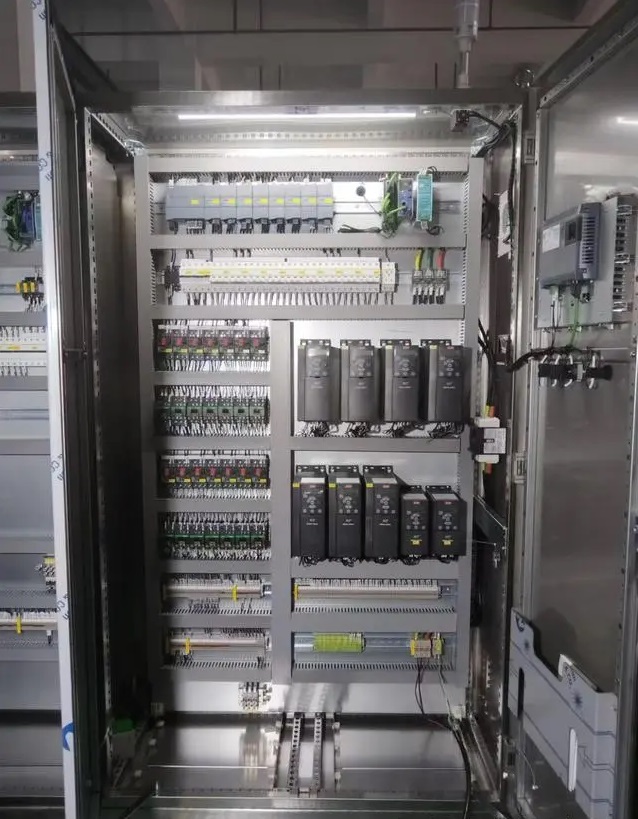
The following are the basic steps and relevant points for designing a temperature control system based on PLC:
- System requirements analysis
Determine the control object: for example, heating furnace, reactor, air conditioning system, etc., clarify its requirements for temperature control, including temperature range, accuracy, heating/cooling rate, etc.
Determine the type of temperature sensor: such as thermocouple, thermal resistor, etc., consider its measurement range, accuracy, response time and other characteristics to meet system requirements.
Determine the actuator: common ones are heating wire, cooling fan, steam or coolant controlled by solenoid valve, etc., select the appropriate actuator and its power and control method according to the control object and process requirements.
- Hardware design
PLC selection:
Select the appropriate model of PLC according to the number of input and output points of the system (temperature sensor signal input, actuator control signal output, etc.), the complexity of control function, communication requirements, etc. For example, Siemens S7-1200 series is suitable for small and medium-sized control systems, and S7-300/400 series can be used for larger-scale and complex systems.
Consider the scalability of PLC so that modules can be easily added when the system is upgraded or the function is expanded in the future.
Temperature sensor and PLC connection:
Thermocouples generally need to use a dedicated thermocouple module to convert millivolt signals into digital signals and input them into PLC. Thermistors can be connected through thermistor modules to convert the resistance value changes into the corresponding temperature digital quantity.
Ensure that the sensor wiring is correct, and take signal shielding and anti-interference measures to prevent external electromagnetic interference from affecting the accuracy of temperature measurement.
Actuator and PLC connection:
For electric heating equipment such as heating wires, the power supply can be controlled by the relay output module or transistor output module of the PLC to adjust the heating power.
If the solenoid valve controls the cooling medium, the PLC output signal controls the opening and closing of the solenoid valve. For cooling systems that need to adjust the flow, it may also be necessary to connect a flow control valve and control the opening of the control valve through an analog output module.
- Software design
Programming language selection:
Common programming languages for PLC include ladder diagram (LAD), statement list (STL), function block diagram (FBD), etc. Ladder diagrams are intuitive and easy to understand, suitable for beginners and logic control programming; function block diagrams are suitable for the construction of complex function modules; statement tables are closer to computer assembly language and may be more flexible in the implementation of some specific functions. You can choose a suitable programming language according to your personal programming habits and project requirements.
Temperature acquisition program:
Write a program to read temperature data from the input address corresponding to the temperature sensor, and perform data processing, such as filtering, to remove measurement noise interference to obtain a more accurate temperature value.
Control algorithm design:
Common temperature control algorithms include proportional integral differential (PID) control algorithms.
Determine PID control parameters (proportional coefficient Kp, integral time Ti, differential time Td). The parameter range can be preliminarily determined through theoretical calculations, and then optimized and adjusted during the actual debugging process to achieve good control effects, so that the temperature can quickly and stably reach the set value, and reduce overshoot and steady-state errors.
According to the deviation between the set temperature and the actual measured temperature, the control output is calculated by the PID algorithm, such as the percentage of heating power or the adjustment amount of cooling medium flow.
Actuator control program:
Convert the control output calculated by the PID algorithm into a control signal suitable for the actuator, such as controlling the on-off time ratio of the relay to adjust the heating power, or outputting analog signals to control the opening of the regulating valve to adjust the cooling flow, etc.
Write the protection program of the actuator, such as heating wire overload protection, cooling system fault detection and alarm, etc., to ensure the safe and reliable operation of the system.
IV. System debugging and optimization
Hardware debugging:
Check whether the PLC hardware wiring is correct, including power wiring, input and output module wiring, etc.
Separately debug the temperature sensor and the actuator to verify whether their functions are normal. For example, heat or cool the temperature sensor, check whether the temperature data collected by the PLC changes accurately; manually control the actuator action and observe whether it runs normally.
Software debugging:
Online monitoring of PLC program operation, check whether the temperature acquisition program reads the temperature data correctly, and whether the control algorithm calculates and outputs the control signal as expected.
Adjust the PID parameters gradually, observe the temperature control effect, record the response curve of the system under different parameters (temperature change curve over time), analyze the overshoot, adjustment time and other indicators, until the best PID parameter combination is found.
System joint debugging:
After the hardware and software are debugged normally, the whole temperature control system is joint debugged. Set different temperature values, observe the whole control process of the system from the initial temperature to the set temperature, and check the stability, accuracy and reliability of the system.
Test the system for a long time, observe whether there are problems such as temperature drift and actuator failure, and optimize and improve them in time.
Through the above steps, a PLC-based temperature control system can be designed and implemented to meet the temperature control requirements in various industrial production or equipment operation, improve production efficiency and product quality, and ensure the safe and stable operation of the system.