Introduction
In industrial automation and robotics, selecting the right motion controller is crucial for efficiency, precision, and scalability. With options like PLCs, PC-based, and specialized controllers, understanding their strengths and limitations is key. This blog breaks down each type to guide your decision.

1. Programmable Logic Controllers (PLCs)
Overview: Rugged and reliable, PLCs are industry staples for automation.
Strengths:
- Durability: Built for harsh environments (e.g., factories).
- Deterministic Performance: Excel in real-time, repetitive tasks.
- Ease of Integration: Compatible with sensors, HMIs, and industrial networks.
- Cost-Effective: Moderate upfront costs and long lifecycle.
Limitations: - Complexity: Ladder logic may limit advanced motion algorithms.
- Scalability: Modular but may require additional cards for complex tasks.
Best For: Packaging lines, conveyor systems, and simple motion control.
2. PC-Based Controllers
Overview: Leverage computer power for flexibility and high-speed processing.
Strengths:
- High Computational Power: Handles complex algorithms (e.g., 3D path planning).
- Flexibility: Programmable in C++, Python, or MATLAB.
- Connectivity: Integrates with IT systems and IoT platforms.
- Scalability: Upgradable hardware/software for evolving needs.
Limitations: - Environmental Sensitivity: May need protective enclosures.
- Reliability: Potential OS instability, mitigated by real-time OS (e.g., RTOS).
Best For: CNC machining, 3D printing, and data-intensive tasks.
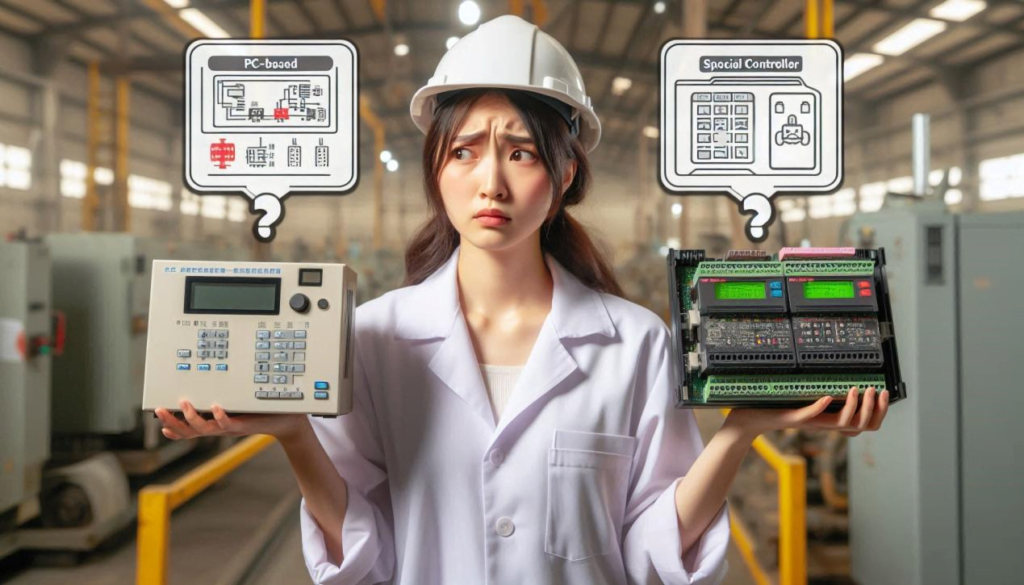
3. Specialized Motion Controllers
Overview: Tailored for high-performance applications.
Strengths:
- Precision: Optimized for tasks like robotics or semiconductor manufacturing.
- Speed: Ultra-fast processing for sub-millisecond responses.
- Integration: Often include dedicated I/O for motors/encoders.
Limitations: - Cost: Higher upfront and niche expertise requirements.
- Flexibility: Less adaptable to new tasks post-deployment.
Best For: High-speed robotics, medical devices, and aerospace.
Key Decision Factors
- Application Complexity: Simple tasks favor PLCs; complex algorithms demand PC-based or specialized.
- Environment: Harsh conditions suit PLCs; controlled settings allow PC use.
- Integration Needs: PLCs for industrial networks; PC-based for IT/cloud connectivity.
- Budget: Balance upfront costs (specialized) vs. long-term scalability (PC-based).
- Future-Proofing: Consider IIoT and AI trends; PC-based systems adapt well.
Examples in Action
- Automotive Assembly: PLCs for repetitive welding tasks.
- Custom CNC Machine: PC-based for adaptive toolpaths.
- Delta Robot: Specialized controller for high-speed pick-and-place.

Future Trends
- IIoT Integration: Controllers increasingly connect to cloud analytics.
- Edge Computing: Real-time data processing at the source.
- AI-Driven Control: Machine learning for predictive adjustments.
Conclusion
Your choice hinges on balancing performance, environment, and scalability. PLCs offer reliability, PC-based systems bring flexibility, and specialized controllers deliver unmatched precision. Assess your project’s needs against these profiles to future-proof your automation strategy.