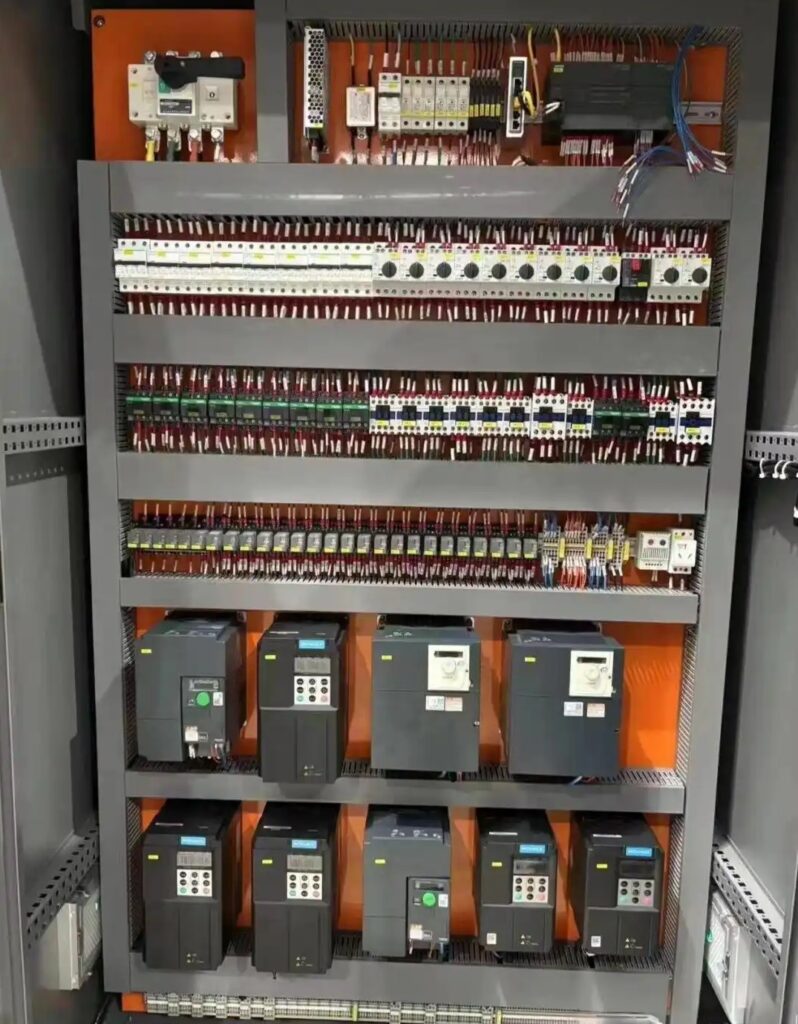
To ensure the safety of PLC control cabinets in chemical production, measures can be taken from hardware design and selection, software programming and debugging, installation and maintenance, etc., as follows:
Hardware
Reasonable selection: According to the characteristics and control requirements of the chemical production environment, select PLC control cabinets with corresponding protection levels and strong anti-interference capabilities. For example, in areas with explosion-proof requirements, explosion-proof PLC control cabinets should be selected; for environments with strong electromagnetic interference, products with good electromagnetic compatibility should be selected.
Redundant design: Using key hardware such as redundant power supply and redundant CPU, when one component fails, the other can immediately take over the work to ensure uninterrupted operation of the system. A dual-channel communication network can also be set up to ensure the reliability of data transmission.
Install protection device: Install surge protector to prevent surge voltage generated by lightning strikes or power fluctuations from damaging electronic components in the PLC control cabinet. At the same time, equipped with overcurrent, overvoltage, and undervoltage protection devices, when the power supply is abnormal, the circuit can be cut off in time to protect the safety of the equipment.
Software
Safety programming: When writing PLC programs, follow strict safety programming specifications and adopt modular and structured programming methods to improve the readability and maintainability of the program. Set up safety interlock logic to ensure that the equipment can only perform corresponding operations when all safety conditions are met.
Fault diagnosis and processing procedures: Write a complete fault diagnosis program to monitor the operating status of the PLC system in real time. Once a fault is detected, it can quickly locate the fault point and take corresponding processing measures, such as automatic shutdown and alarm. At the same time, record the fault information so that maintenance personnel can analyze and handle it.
Software testing and verification: Before the PLC software is put into use, conduct comprehensive testing and verification, including functional testing, performance testing, safety testing, etc. By simulating various working conditions and fault scenarios, check the correctness and stability of the program to ensure that the software has no security vulnerabilities.
Installation and wiring
Correct installation: The PLC control cabinet should be installed in a dry, ventilated, vibration-free place, away from high temperature, humidity, corrosion and strong electromagnetic interference sources. During installation, ensure that the cabinet is well grounded and the grounding resistance meets the requirements, generally not more than 4Ω, to ensure the safety of equipment and personnel.
Reasonable wiring: Rationally plan the wiring of the PLC control cabinet, and lay the power line, signal line, control line, etc. separately to avoid mutual interference. For analog signal lines, shielded cables should be used, and the shielding layer should be reliably grounded. At the same time, the wiring should be neat and standardized to facilitate maintenance and repair.
Operation and maintenance
Personnel training: Professional training is provided to personnel who operate and maintain the PLC control cabinet to make them familiar with the working principle, operation method, safety precautions, etc. of the equipment. Operators must operate in strict accordance with the operating procedures, and illegal operations are strictly prohibited.
Regular maintenance and inspection: Develop a detailed maintenance plan, and regularly inspect and maintain the PLC control cabinet, including cleaning the cabinet, checking whether the connecting wires are loose, and checking whether the electronic components are aging and damaged. Regularly back up the PLC program to prevent program loss or damage.
Emergency plan development: Develop a comprehensive emergency plan to clarify the response measures in the event of a PLC control cabinet failure or emergency, including how to shut down safely, how to troubleshoot and repair faults, how to ensure the safety of personnel and equipment, etc. Regularly rehearse the emergency plan to ensure that relevant personnel are familiar with the emergency handling process.