(I) Control processing capability
A PLC controller can often handle thousands of I/O points, while a DCS controller can generally only handle hundreds of I/O points. From the perspective of the distributed system, centralized control is not allowed, so the DCS developers focus on providing system reliability and flexibility. In contrast, as an independent flexible control device, PLC has a very strong point-carrying capability. For example, in some large-scale automated production lines, it may be necessary to handle control tasks for thousands of I/O points, and at this time, PLC can play its advantages. In terms of computing speed, PLC is very efficient in executing logical operations, executing 1K logic programs in less than 1 millisecond, and its control cycle can be controlled within 50ms; while DCS uses the same method when processing logical operations and analog operations, and its control cycle is often above 100ms. However, the new DCS controller has learned the design of large PLCs, and its performance in control cycle has been greatly improved. Taking the T2550 controller of NETWORK6000+DCS as an example, the controller can set four tasks of different priorities, and the minimum operation cycle can be set to 10ms. In combination with high-speed I/O cards, the control cycle can reach 15~20ms.
(II) Data communication exchange
DCS has inherent advantages in data communication exchange. Since the early days of DCS development, the network has become the core technology direction of DCS manufacturers. Redundancy technology and narrowband transmission technology were the first to be developed or successfully applied by DCS manufacturers. PLC is mainly designed as an independent device, and its “network” is actually serial communication. The problem of PLC data communication exchange mainly stems from the fact that PLC has been developed as an independent device for a long time without a system concept; and it is mainly used in small control systems, so the problem is not obvious, so it develops slowly. At present, some large PLCs have improved in this aspect, but it will take a long time to reach the level of DCS. For example, in a large chemical production enterprise, the DCS system can realize real-time monitoring and control of each production link through high-speed network communication, while PLC may be unable to handle large-scale data communication.
(III) Configuration maintenance function
After years of development, DCS has accumulated a large number of advanced algorithm modules. For example, the device-level module of NETWORK6000+ completes the basic control and fault alarm functions for the device in one module, and the module is used as a unit for transmission in network communication, which greatly improves the efficiency of software development. One device-level module is equivalent to 0.5K of ladder logic. It is much more complicated for PLC to complete the same function. In the early days, PLC was mainly based on ladder diagrams, and DCS was mainly based on module function diagrams. After years of development, the International Electrotechnical Commission has specified five programming languages through the IEC1131-3 standard. The current mainstream DCS and PLC have expressed compliance with this standard and support several or all of the programming languages. Considering development efficiency and program readability, module function diagrams and sequential function diagrams are increasingly becoming the main programming methods, and ladder logic and structured text have become the development tools for custom modules. Large PLCs are becoming more and more like DCS in configuration methods, and the gap is gradually narrowing, while small PLCs are still mainly based on ladder diagrams.
(IV) Hardware packaging structure
PLC is generally a large-bottom rack with closed I/O modules. The closed structure is conducive to improving the reliability of I/O modules, and is resistant to radio frequency, static electricity, and damage. The I/O points of PLC modules are 8 points, 16 points, and 32 points. Most DCSs are 19-inch standard chassis with plug-in I/O modules, and the I/O modules are exposed structures. Each module has 8 and 16 I/O points, and 32-point modules are rarely used. This structure of DCS is due to its main use in large control objects. The 19-inch standard chassis is convenient for dense layout, and the fewer I/O points are due to the requirement for dispersion. The large-bottom rack and closed module structure of PLC are more flexible in management and configuration, and the reliability of a single device is higher. Therefore, many DCSs have also absorbed the structural advantages of PLCs and adopted a packaging structure similar to that of PLCs, such as I/A using a metal shell and NETWORK-6000+ using a conductive plastic shell.
(V) Human-machine interaction device
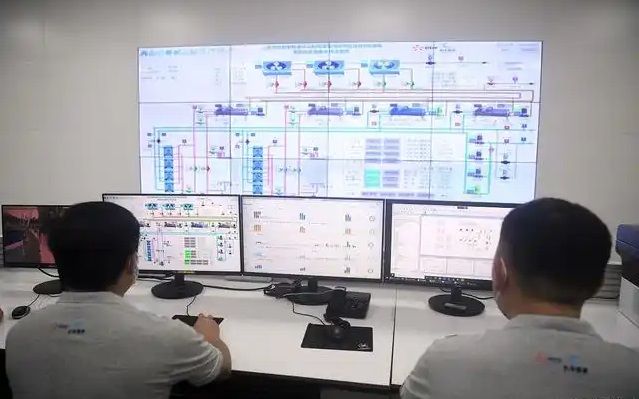
In the early days, as a system, the human-machine interaction device of DCS was a special device provided by the DCS manufacturer. PLC manufacturers generally do not provide human-machine interaction devices, and often the engineering company independently uses general monitoring software to complete it (such as ifix, intouch, and Kingview). The human-machine interaction device integrated in DCS often has the characteristics of more professional functions and better stability, but its price is also very high. With the rapid development of PC technology, some general monitoring software has developed rapidly, and its functions and performance have gradually surpassed the special devices provided by DCS manufacturers. Therefore, many DCS manufacturers have gradually abandoned the special human-machine interaction device and switched to using general monitoring software like PLC. DCS manufacturers do not simply assemble general monitoring software, but through cooperative development based on general monitoring software, they retain and inherit their own network communication technology and system self-diagnosis technology accumulated over the years in the form of special software packages. For example, in an electric power monitoring system, the human-computer interaction device of the DCS can provide more professional functions, such as real-time monitoring and fault diagnosis of generator sets, while the PLC needs to use general monitoring software to achieve similar functions.