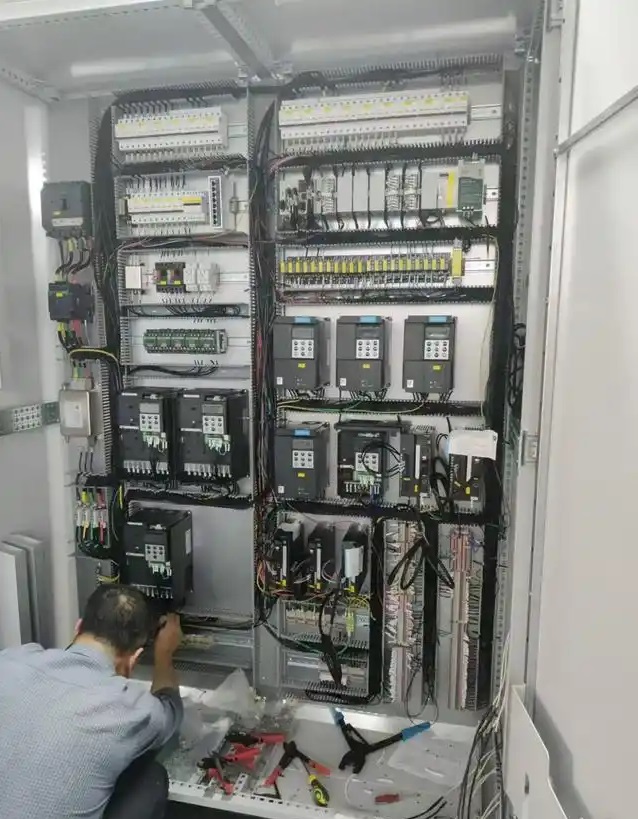
As an important part of modern industrial automation, the layout of PLC electrical control cabinet is not only related to the stable operation of the equipment, but also directly affects the maintenance efficiency and safety in the later stage. Reasonable layout can not only improve the performance of the equipment, but also extend the service life and reduce the failure rate.
Layout principles
The layout of PLC electrical control cabinet should follow the following basic principles:
- Functional principle: According to the functional requirements of the equipment, the area should be reasonably divided. For example, input and output modules, power modules, communication modules, etc. should be placed in different areas for easy management and maintenance. This modular design not only improves the readability of the equipment, but also facilitates troubleshooting and maintenance.
- Safety principle: Ensuring the safety of the equipment is the top priority. During the layout process, the dust, moisture, and shock requirements of the equipment should be considered, while ensuring the safe distance between the equipment and personnel. For potential dangerous areas such as high voltage and high temperature, corresponding protective measures should be taken, such as setting up isolation fences and warning signs.
- Maintainability principle: Considering the maintenance needs of the equipment, sufficient space should be left during the layout to facilitate operation and maintenance by staff. In addition, the maintenance channels and access ports of the equipment should be reasonably designed to ensure rapid response in emergency situations.
- Scalability principle: With the continuous development of technology and the increase in the number of equipment, scalability has become an important consideration for layout. When laying out, a certain amount of space should be reserved to facilitate the expansion and upgrading of equipment in the future. This not only reduces the cost of future renovations, but also improves the flexibility of the system.
Specific layout method
On the basis of following the above principles, the specific layout method of the PLC electrical control cabinet includes the following steps:
- Equipment installation: According to the function and size of the equipment, the installation location should be reasonably selected. For equipment with heavy weight and large volume, it should be installed at the bottom of the control cabinet or near the load-bearing wall to ensure stability. At the same time, the heat dissipation requirements of the equipment should be considered to avoid performance degradation due to overheating.
- Wire trough and wiring: The selection of wire troughs should be determined based on the total volume of the wires passing through the wire trough (including insulation). Commonly used wire trough widths include 25mm, 35mm, 40mm and other specifications, and there are also multiple options for height. When wiring, the principle of “from top to bottom, from left to right” should be followed to avoid repeated winding of wires in the wire trough to ensure that the lines are neat and easy to maintain. Special cables, such as network cables, prefabricated cables for components, etc., should be managed separately for easy distinction and management.
- Arrangement of components:
Power supply: The power supply does not require frequent maintenance and is a heat-generating device. It should be arranged at the top of the cabinet to facilitate heat dissipation. At the same time, it should be ensured that it maintains a certain safe distance from the surrounding components to prevent overheating and malfunctions.
PLC and each unit: The unit adjacent to the PLC and CPU unit is preferably a special unit and input unit with less interference. The electromagnetic contactor and relay of the external circuit, whose coils and contacts are the source of interference, should be configured separately from the PLC to reduce the impact of interference on system performance.
Circuit breaker: The installation height of the circuit breaker should be convenient for operation, and there should be no devices around that hinder operation. At the same time, its scalability should be considered, and sufficient space should be reserved for the addition of new circuit breakers in the future.
Relays and terminal blocks: Relays and terminal blocks are generally arranged in the lower front or back of the cabinet. The terminal blocks are preferably arranged vertically. The cable troughs for internal and external lines should be separated as much as possible for easy management and maintenance.
Switches and fiber optic boxes: Switches and fiber optic boxes are generally arranged in the lower part of the cabinet. The reserved wiring space should fully consider the bending radius of the network cable and optical fiber to ensure convenient access to the network cable and optical fiber on site. - Grounding system: In the PLC system, all control cabinets equipped with PLC equipment should be equipped with PE protection grounding busbars and TE anti-interference grounding busbars. A good design of the grounding system is essential to ensure the stable operation of the equipment. At the same time, it should be ensured that the potential distribution of all grounding points is uniform to avoid interference with the system caused by grounding loop current.
- Lighting and ventilation: Lighting should be installed in the control cabinet and controlled by the door switch. This not only facilitates the staff to operate and maintain at night or in low light conditions, but also improves work efficiency. At the same time, the ventilation design of the control cabinet should be considered to ensure that the heat dissipation requirements of internal components are met. Usually, the air inlet is from the bottom of the front door and the air outlet is from the top of the front door, and the rear door is not equipped with air inlet and outlet holes. The air inlet and outlet are each equipped with a ventilation filter to prevent dust to ensure the cleanliness of the internal environment.
Component layout details
In the component layout of the PLC electrical control cabinet, the following details should also be noted:
Module arrangement: The module is the main component of the PLC system and requires frequent debugging and maintenance. Therefore, when installing the module, it should be arranged from left to right to facilitate expansion and signal line connection. At the same time, the heat dissipation requirements of the module should be considered to avoid overheating and performance degradation.
Wire trough and rack: The net distance between the wire trough and the rack should be reasonably designed according to actual needs. For example, the net distance between the upper end of the rack and the wire trough is about 30mm, and the net distance between the lower end of the rack and the wire trough should also be kept within an appropriate range. This not only ensures the neatness of the line, but also improves the maintainability of the system.
Grounding connection: In the design of the grounding system, it should be ensured that the connection of all grounding points is firm and reliable. At the same time, factors such as the cross-sectional area and length of the grounding wire should be considered to ensure that the grounding resistance meets the requirements. In addition, the integrity of the grounding system should be checked regularly to promptly identify and deal with potential safety hazards.
Precautions
In the layout of the PLC electrical control cabinet, the following points should also be noted:
Avoid interference: In order to reduce the impact of external interference on system performance, the PLC electrical control cabinet should be installed as far as possible near strong interference sources. For example, strong interference sources such as welding machines, high-power silicon rectifiers and large power equipment should be kept at a certain distance from the PLC electrical control cabinet.
Dust and moisture prevention: In order to extend the service life and performance stability of the equipment, appropriate dust and moisture prevention measures should be taken. For example, dust filters should be installed at the air inlet and outlet of the control cabinet, and dehumidifiers and other equipment should be used when necessary to reduce the humidity inside the control cabinet.
Regular inspection and maintenance: Regular inspection and maintenance of the PLC electrical control cabinet is an important measure to ensure its stable operation. For example, the connection of the line, the integrity of the components, and the reliability of the grounding system should be checked regularly. At the same time, corresponding maintenance plans and maintenance record sheets and other documents should be formulated according to actual needs.
In summary, the layout of the PLC electrical control cabinet is a complex and meticulous task. On the basis of following the basic principles of functionality, safety, maintainability and scalability, the stable operation and efficient maintenance of the PLC electrical control cabinet can be ensured through reasonable equipment installation, cable trough and wiring design, and component layout. At the same time, during the layout process, attention should also be paid to details such as avoiding interference, dust and moisture prevention, and regular inspection and maintenance to ensure the long-term stable operation of the equipment.