There are several reasons for installing a signal isolator in a PLC control cabinet:
- Improve signal anti-interference ability
Resist external interference sources
The industrial field environment is complex, and there are a large number of electromagnetic interference sources, such as large motors, frequency converters, welding machines and other equipment that will generate strong electromagnetic radiation during operation. These interference signals may be coupled to the PLC control system through power lines, signal lines and other channels, affecting the accuracy and stability of the measurement signal.
For example, in a factory workshop, the motor driven by the frequency converter will generate high-order harmonic interference during operation, which may cause fluctuations or errors in the sensor signal received by the PLC. After installing a signal isolator, these external interference sources can be effectively isolated to ensure that the signal received by the PLC is true and reliable.
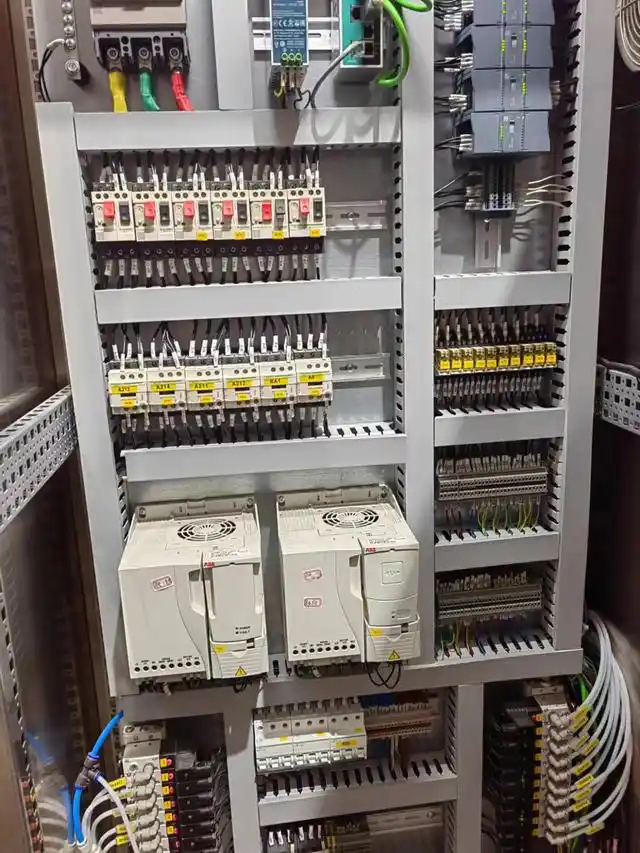
Prevent the propagation of interference within the system
In a PLC control system, there may be mutual interference between different devices and modules. For example, a digital output module may generate transient voltage when switching states, which may affect the normal operation of other modules through a common ground line or power line.
Signal isolators can electrically isolate input signals and output signals, cut off the path of interference propagation, and thus avoid the mutual influence of interference within the system. For example, in a PLC control cabinet, there are multiple analog input modules and output modules. If there is no signal isolator, when one of the modules fails and generates interference, it may affect the normal operation of other modules. After installing a signal isolator, the interference between the modules can be effectively isolated, and the stability of the system can be improved.
- Enhance system safety
Electrical isolation protection
Signal isolators can achieve electrical isolation between input signals and output signals, and the isolation voltage can usually reach thousands of volts or even higher. This can effectively prevent the conduction of dangerous voltages caused by electrical faults (such as short circuits, grounding, etc.) between field equipment and PLC control systems, and protect the safety of PLCs and operators.
For example, in some flammable and explosive environments, such as chemical plants and oil drilling platforms, any electrical sparks may cause serious safety accidents. By installing a signal isolator, it can be ensured that even if the field equipment fails, the dangerous voltage will not be transmitted to the PLC control system, thereby reducing the safety risk.
Protect PLC input and output ports
PLC input and output ports are usually fragile and easily damaged by overvoltage, overcurrent and other factors. Signal isolators can limit the input and output signals by current limiting and voltage limiting to prevent abnormal signals from damaging the PLC ports.
For example, when a field sensor fails and outputs an abnormally high voltage signal, the signal isolator can limit the signal to a safe range to avoid damaging the PLC input port. Similarly, for the PLC output signal, the signal isolator can prevent the reverse current, overvoltage and other external devices from damaging the PLC output port.
- Improve signal transmission accuracy
Eliminate signal distortion
During long-distance transmission, the signal may be attenuated and distorted due to factors such as line impedance and distributed capacitance. Signal isolators usually have signal amplification and shaping functions, which can compensate and repair input signals to ensure the accuracy and stability of output signals.
For example, in a large factory, the distance between the sensor and the PLC control cabinet is far, and the signal may be attenuated and deformed during transmission. After installing a signal isolator, the strength and shape of the signal can be effectively restored, and the transmission accuracy of the signal can be improved.
Achieve signal matching
Different sensors and devices may output signals of different types and ranges, while the input requirements of the PLC are usually specific signal types and ranges. The signal isolator can convert and adjust the input signal to meet the input requirements of the PLC and achieve signal matching.
For example, some sensors output milliampere current signals, while the PLC requires voltage signals to be received. Through the signal isolator, the current signal can be converted into a voltage signal and adjusted to the appropriate range so that the PLC can accurately receive and process it.
- Facilitate system maintenance and fault diagnosis
Isolate the fault point
When a system fails, the signal isolator can isolate the fault point from other parts, which is convenient for quick positioning and troubleshooting. By observing the input and output status of the signal isolator, it can be determined whether the fault occurs on the field device side or the PLC side, thereby narrowing the scope of troubleshooting.
For example, if the PLC shows that the signal of a sensor is abnormal, the input and output signals of the signal isolator can be checked to determine whether it is a fault in the sensor itself or a problem in the signal transmission line. If the input signal of the signal isolator is normal but the output signal is abnormal, it means that the fault may be on the signal isolator or PLC side; if both the input and output signals are abnormal, it means that the fault may be on the field sensor side.
Convenient system debugging
During the system debugging process, the signal isolator can monitor and adjust the input and output signals separately without affecting the normal operation of other parts. This helps to improve debugging efficiency and reduce risks during debugging.
For example, when debugging a new PLC control system, the output signal of the signal isolator can be connected to a test device first, the signal can be verified and adjusted to ensure the accuracy and stability of the signal, and then connected to the PLC input port. This can avoid damage to the PLC due to signal problems during debugging.