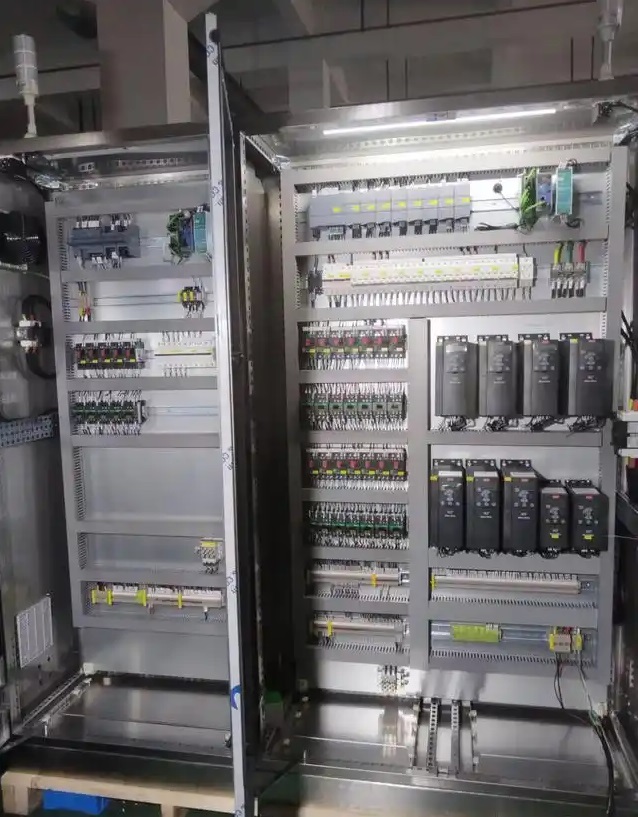
In the field of industrial automation, the PLC (Programmable Logic Controller) control cabinet is the core control device, and its design and configuration are directly related to the stability and efficiency of the entire automation system. Determining the number of I/O (input/output) points of the PLC control cabinet is an important step in the initial planning of the project. It not only affects the selection of PLC and the size layout of the control cabinet, but also affects the subsequent programming, debugging and system maintenance. This article will discuss in detail how to scientifically and reasonably determine the number of I/O points of the PLC control cabinet to ensure the smooth implementation of the project and meet the long-term operation requirements.
- Clarify project requirements and process flow
First, in-depth understanding of the specific needs of the project is the basis for determining the number of I/O points. This includes the process flow of the production line, the action sequence of the equipment, the types and quantities of sensors and actuators, etc. For example, on an automated assembly line, the input signals that need to be counted may include workpiece arrival signals detected by sensors (such as photoelectric switches, proximity switches), operation instructions on buttons or touch screens, etc.; output signals may include motor start/stop, cylinder extension, indicator light on and off, etc. By analyzing the process flow in detail and listing all possible input and output points, this is the first step in determining the number of I/O points.
- Consider redundancy and scalability
After determining the initial number of I/O points, the redundancy and future scalability of the system must also be considered. Redundant design can improve the reliability of the system and avoid system downtime caused by single-point failures. For example, for key input signals, dual sensor detection can be designed to ensure the accuracy of the signal through logical judgment. At the same time, considering the possible addition of equipment or functions in the future, a certain proportion of I/O points should be reserved as backup. It is generally recommended to reserve 10%-20% of the margin so that it can easily cope with changes in future needs without changing the PLC hardware.
- Choose the right PLC model and brand
The selection of PLC directly affects the configuration of I/O points. PLCs of different brands and models have different types, quantities, and performances of I/O modules. Therefore, before determining the number of I/O points, it is necessary to compare and analyze the mainstream PLC products on the market, and select the most suitable PLC model based on project requirements, cost budget, technical support and other factors. For example, for large and complex projects, you may need to choose a PLC with high-speed processing capabilities, rich expansion modules, and powerful network communication functions; while for small and simple projects, you may pay more attention to cost-effectiveness and ease of use.
- Refine the classification and statistics of I/O points
After determining the PLC model, it is necessary to further refine the classification and statistics of I/O points. According to the signal type, I/O points can be divided into digital quantities (DI/DO) and analog quantities (AI/AO). Digital quantities are mainly used for the input and output of switch signals, such as buttons, relay contacts, LED indicators, etc.; analog quantities are used to process continuously changing physical quantities, such as temperature, pressure, flow, etc. In addition, factors such as the voltage level of the signal, signal isolation requirements, and whether special function modules (such as high-speed counters, PID controllers) are required must also be considered. By refining the classification, the I/O modules can be configured more accurately to improve the compatibility and efficiency of the system.
- Use software tools for simulation and verification
After determining the number of I/O points and the configuration plan, you can use the software tools provided by the PLC manufacturer for simulation and verification. These tools usually allow users to create virtual PLC systems, simulate actual input and output operations, check the correctness of program logic, and even perform performance analysis. Through simulation operation, potential problems such as I/O resource conflicts and long response time can be discovered, so that the number of I/O points can be adjusted in time or the program design can be optimized to avoid major modifications in the later debugging stage.
- Consider the convenience of on-site installation and maintenance
When determining the number of I/O points, the convenience of on-site installation and maintenance should also be considered. For example, the installation location of the I/O module should be convenient for wiring and operation, avoiding overcrowded or difficult-to-reach areas; for input and output points that frequently require maintenance, easy-to-replace plug-in modules should be considered; at the same time, considering the on-site environment (such as temperature, humidity, electromagnetic interference, etc.), select the appropriate protection level and anti-interference measures to ensure the stable operation of the system.
- Comprehensive evaluation and adjustment
Finally, based on the above factors, the configuration plan of the I/O points is comprehensively evaluated. This includes cost-benefit analysis, technical feasibility evaluation, system flexibility and scalability considerations, etc. If any unreasonableness is found, adjustments should be made in time until the optimal solution is found. Remember, determining the number of I/O points is a dynamic process that needs to be continuously revised and improved as the project progresses.
Conclusion
Determining the number of I/O points of the PLC control cabinet is a key link in automation project planning, which is directly related to the success of the project. By deeply understanding the project requirements, considering redundancy and scalability, selecting the appropriate PLC model, refining the classification and statistics of I/O points, using software tools for simulation verification, considering the convenience of on-site installation and maintenance, and comprehensive evaluation and adjustment, the rationality of the I/O point configuration can be ensured, laying a solid foundation for the smooth implementation of the project. In actual operation, it is also necessary to combine the characteristics of the specific project, flexibly apply the above methods, and continuously explore and optimize in order to achieve the best design effect.