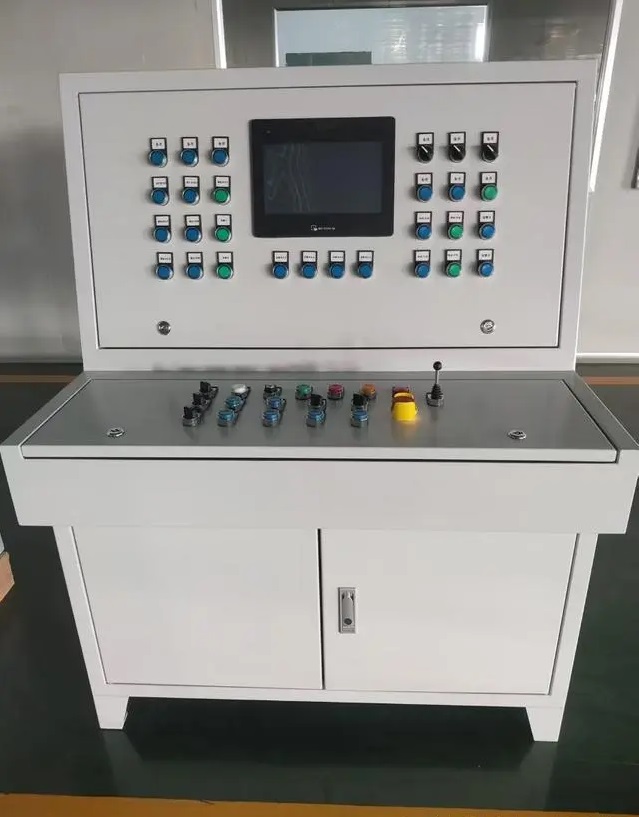
Industrial automation cannot do without PLC control systems. The main reasons are as follows:
High reliability
Adapt to harsh environments: The hardware design of PLC fully considers the harsh environment of industrial sites, such as high temperature, humidity, dust, electromagnetic interference, etc. It uses a sturdy and durable shell and electronic components with strong anti-interference ability. It can operate stably and reliably under harsh working conditions and reduce downtime caused by environmental factors.
Self-diagnosis and protection: PLC has a powerful self-diagnosis function and can monitor its own operating status in real time. Once an abnormality is found, such as power failure, CPU failure, I/O module failure, etc., it will immediately send an alarm signal and take corresponding protection measures, such as automatically switching to a backup module or stopping operation, to prevent the fault from further expanding and ensure the safety and reliability of the entire system.
Flexible programming
Support for multiple programming languages: PLC supports multiple programming languages, such as ladder logic, function block diagram, structured text, instruction table and sequential function diagram, etc. Ladder logic imitates circuit diagram, which is intuitive and easy to understand, and easy to be mastered and used by electrical engineers and technicians, while high-level languages such as structured text are suitable for complex mathematical operations and logical processing. Users can choose the appropriate programming language for program development according to specific control requirements and personal programming habits to achieve precise control of the production process.
Quick modification and adjustment: In the industrial production process, product types, process flows or control requirements may change frequently. The programming flexibility of PLC allows users to easily modify and adjust the control program without large-scale changes to hardware equipment. It can quickly adapt to new production needs, greatly improving the flexibility and efficiency of production.
Easy to expand
Modular design: PLC adopts a modular structural design, including CPU module, input and output module, communication module, power module, etc. Users can flexibly select and combine different modules according to the needs of actual applications to build a system suitable for specific control tasks. When the control scale is expanded or new functions need to be added, only the corresponding modules need to be added, without redesigning the entire system, which reduces the upgrade cost and complexity of the system.
Communication expansion capability: PLC has a variety of communication interfaces and communication protocols, such as RS-232, RS-485, Ethernet, Modbus, Profinet, etc., which can easily communicate with other devices and systems, such as sensors, actuators, host computers, SCADA systems, MES systems, etc., to achieve data exchange and sharing, thereby building a complete industrial automation control system to meet the needs of enterprises for centralized monitoring, management and optimization of production processes.
High control accuracy
Accurate signal processing: PLC can accurately collect, convert and process analog and digital signals from sensors, and convert them into accurate control signals to output to actuators, thereby achieving accurate control of various physical quantities in the production process, such as temperature, pressure, flow, position, speed, etc., to ensure the stability and consistency of product quality and improve production efficiency.
Stable timing control: In some industrial production processes that require strict timing control, such as automated assembly production lines and packaging production lines, PLC can achieve precise timing control of each process and equipment through precise timer and counter functions, ensuring the orderly progress of the production process and avoiding production accidents and quality problems caused by time errors.
Strong data processing capabilities
Data acquisition and storage: PLC can collect a large amount of data in the production process in real time and store it in internal registers or external storage devices. These data include the operating status of the equipment, process parameters, production data, etc., providing rich data support for the company’s production management and decision-making.
Data analysis and decision-making: With the help of advanced data analysis algorithms and tools, PLC can analyze and process the collected data, such as statistical analysis, trend analysis, fault diagnosis, etc., to extract valuable information from it, help enterprise managers to understand the production status in a timely manner, discover potential problems, formulate reasonable production plans and decisions, optimize the production process, and improve the economic benefits and competitiveness of the enterprise.
Friendly human-machine interaction
Intuitive operating interface: PLC is usually equipped with a human-machine interface (HMI), such as a touch screen, text display, etc. Through these interfaces, operators can intuitively view various data, equipment status and alarm information in the production process, and can also manually control the equipment, set parameters and call programs through touch operation or key input, etc., conveniently and quickly perform human-machine interaction, and improve the convenience and efficiency of production operations.
Remote monitoring and operation: With the development of industrial Internet of Things technology, PLC also supports remote monitoring and operation functions. Through network connection, managers and technicians can monitor the production process in real time through terminal devices such as computers, tablets or smart phones away from the production site, and perform remote parameter adjustment, fault diagnosis and maintenance operations, etc., realizing the control of the production process anytime and anywhere, and improving the management efficiency and response speed of the enterprise.