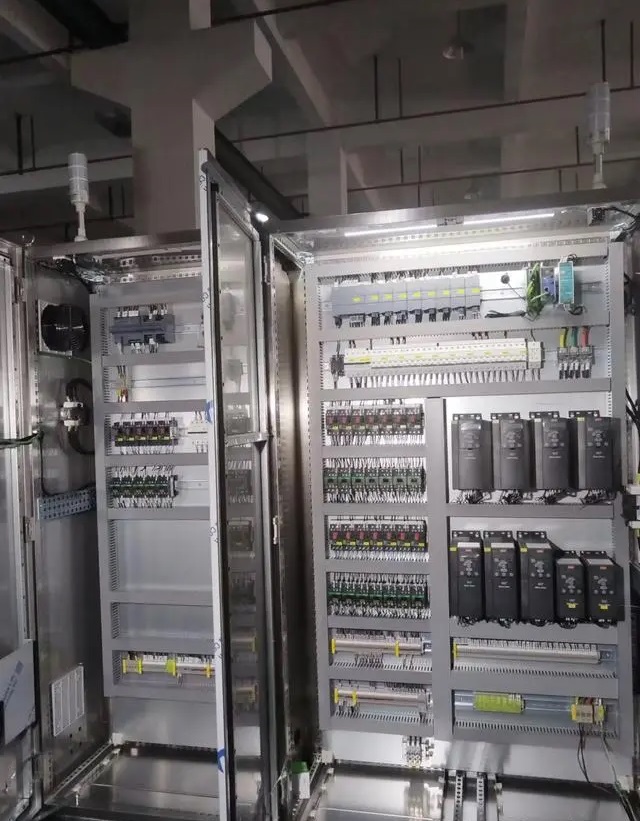
Abnormally high temperature of heat sink
Dust accumulation:
If there is a lot of dust on the surface of the heat sink, it will hinder the dissipation of heat. Because dust has poor thermal conductivity, it will form an insulation layer on the surface of the heat sink. You can judge by observing whether there is obvious dust coverage on the surface of the heat sink. For example, if you touch the heat sink with your hand and feel that the temperature is too high, and you see that there is dust between the heat sink fins, this is likely to be a fault caused by dust.
In addition, in some industrial sites with harsh environments, such as cement plants and coal mines, dust is generated quickly and in large quantities, and the heat sink is more likely to be blocked by dust.
Poor contact between the heat sink and the heating element:
When the connection between the heat sink and the heating element (such as the PLC module) is loose or the thermal grease is dry and unevenly applied, the heat cannot be effectively transferred from the heating element to the heat sink. You can check whether the screws fixing the heat sink are loose, or observe whether there is a gap between the heat sink and the heating element. For example, vibration during the operation of the equipment may cause a gap between the heat sink and the heating element that were originally tightly fitted.
Damage to the heat sink itself:
If the fins of the heat sink are deformed or broken, the heat dissipation area will be reduced and the heat dissipation efficiency will be affected. This may be due to external impact or material aging caused by long-term exposure to high temperature. You can judge by visually checking the state of the fins. If you find that the fins have obvious bends or broken parts, it means that the heat sink structure itself is damaged.
Uneven temperature distribution of the heat sink
Internal blockage:
For some heat sinks with internal channels, if the internal channels are blocked by debris, solidified coolant (if it is a liquid-cooled heat sink), etc., the heat will not be evenly conducted inside the heat sink. You can judge by checking whether there are foreign objects at the inlet and outlet of the heat sink, or by performing an internal inspection of the heat sink during equipment maintenance (such as disassembly inspection, if possible).
Excessive local thermal resistance:
It may be that there is an oxide layer or dirt on the surface of the heat sink, which causes the thermal conductivity of this part to decrease. You can use professional testing equipment (such as thermal imagers) to observe the temperature distribution of the heat sink. If you find that the local temperature is significantly higher than other parts and exclude external factors (such as proximity to other heat sources), it may be due to excessive local thermal resistance.
PLC system frequently overheats
Degradation of the overall performance of the cooling system:
In addition to the problem of the heat sink itself, it may also be that the entire cooling system (including fans, vents, etc.) fails, causing the heat sink to fail to dissipate heat effectively. For example, the fan that works with the heat sink is damaged and cannot provide enough air flow to remove heat, causing the heat sink temperature to continue to rise, which in turn triggers the overheat alarm of the PLC system. You can check whether the fan is operating normally and whether the vents are unobstructed.